
The 10-Second Story: Vertical Power Delivery Revolutionizes AI Infrastructure
The relentless demand for processing power in artificial intelligence is fundamentally reshaping how data centers are designed, with vertical power delivery emerging as a critical innovation. Traditional power delivery networks (PDNs) are struggling to keep pace with the immense current requirements of modern AI accelerators, forcing a paradigm shift towards more integrated and efficient power management solutions.
Table of Contents
This evolution is driven by the need to deliver massive amounts of current at very low voltages, often below 1V, to GPUs and other AI chips. As these chips consume hundreds of watts, the current can reach 1,000 amps or more. This necessitates a radical rethinking of how power reaches the silicon, moving beyond conventional board-level distribution to solutions that place power regulation much closer to the point of load.
Architectural Shifts: From Board-Side to Integrated Power Solutions
The core challenge lies in minimizing resistive losses (IR drop) and voltage droop across the PDN. As AI accelerators push towards 600W or higher, and operate at voltages as low as 0.7V, the current demands skyrocket. This exacerbates the impact of even milliohm-level resistances found in traditional PDNs, directly impacting performance and efficiency.
To combat this, the industry is embracing vertical power delivery architectures. This involves relocating voltage regulator modules (VRMs) from the periphery of the printed circuit board (PCB) to locations much closer to the processors. Initial steps included backside power delivery networks (BPDNs) nearly a decade ago, integrating power delivery directly on the wafer backside.
Current advancements extend this concept further, embedding power management ICs (PMICs) and integrated voltage regulators (IVRs) directly within the advanced package, onto the interposer, or even beneath the PCB. This proximity drastically reduces the length of the high-current path, thereby minimizing IR drop and improving voltage regulation granularity.
The trend is further supported by advancements in compact passive components, such as high-performance inductors and capacitors, which enable smaller, more integrated power solutions. This allows for the creation of sophisticated systems where power management is co-designed alongside the AI accelerators, memory, and interconnects.
Engineering Trade-offs: Complexity and System Co-Design
Implementing vertical power delivery is not without its complexities. It demands a holistic system co-design approach, integrating the PDN, interposer, PMICs, IVRs, and passive components with the custom high-performance computing (HPC) and memory devices. This requires close collaboration across the supply chain, from foundries and fabless designers to substrate suppliers and outsourced semiconductor assembly and test (OSAT) providers.
“The OSAT sits where die, substrate or interposer, passives, and board meet, so we are brought in earlier to model the package-level PDN and co-simulate it with the customer’s die power data,” explains Alex Kizeev, technical director of signal and power integrity at Amkor. This partitioning of the PDN budget across die, package, and board is crucial for optimal results.
Furthermore, moving power delivery structures to the backside of the chip can complicate thermal management. The paths available for heat removal become more intricate, necessitating a co-optimization of power integrity and thermal management. This intricate interplay highlights the need for advanced simulation tools and close collaboration.
The increasing power demands also present significant challenges. For instance, scaling from a 1kW GPU to a 5kW GPU shows how resistive losses can jump from 8% to 31%, and voltage droop from 17% to 31%, even with constant VR losses. This degradation in PDN efficiency at higher power levels underscores the necessity of vertical integration.
The transition to 800V DC power distribution in next-generation data centers further emphasizes the importance of efficient power conversion. By stepping down voltage in stages closer to the load, system-level efficiency improves, and thermal cooling requirements are reduced. This approach, exemplified by solutions like ASE’s PowerSiP and Marvell’s Package Integrated Voltage Regulator (PIVR) technology, aims to shorten the low-voltage, high-current routing path between the regulator and the processor.

Field Readiness and Verdict: A Necessary Evolution for AI Dominance
The industry is rapidly moving towards integrated voltage regulators (IVRs) as a key enabler for advanced AI systems. Companies like Analog Devices, through its acquisition of Empower Semiconductor, and onsemi, with its pending acquisition of Ferric, are heavily investing in this space. These acquisitions underscore the strategic importance of IVR technology for delivering the power density and efficiency required by next-generation AI hardware.
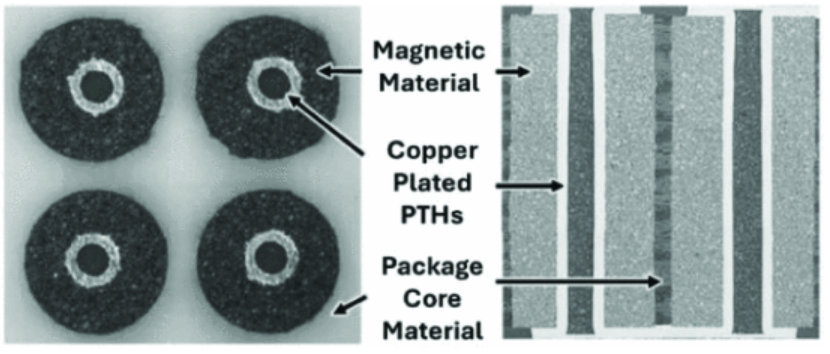
An IVR typically replaces discrete off-chip components with a 3D stack of integrated magnetics and passives mounted directly onto the silicon or package. This integration, often involving deep-trench capacitors and thin-film inductors, brings power conversion extremely close to the System-on-Chip (SoC).
“The IVR is implemented as a 3D stack, bringing together the deep-trench capacitor, PMIC, and inductor, and embedding them directly into the substrate or interposer,” notes Veshal Sridhar, product engineering architect, 3D IC at Synopsys. This proximity minimizes signal parasitics and reaction times to voltage droop events, enabling faster and more precise voltage tuning across different chip areas.
While the path to widespread adoption involves overcoming significant design and manufacturing hurdles, the benefits of vertical power delivery are undeniable. For AI accelerators to reach their full potential, efficient, high-current power delivery is paramount. The ongoing innovation in IVRs and advanced packaging techniques signifies that vertical power delivery is not just an option, but a necessity for the future of high-performance computing and AI infrastructure.
Source: Semiconductor Engineering