
Meta’s AI Agents Unlock Massive ML Scaling for Ad Ranking
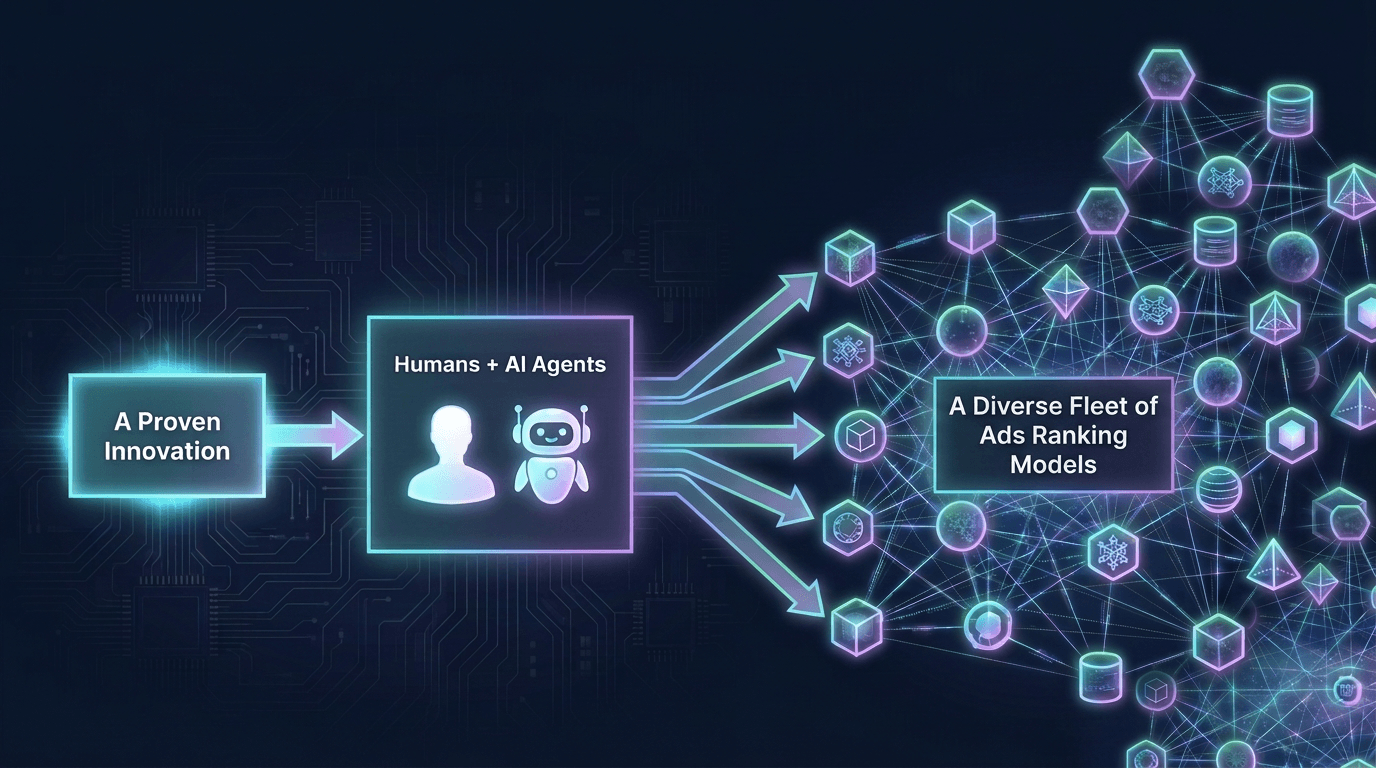
Meta is pioneering a new era in machine learning (ML) innovation by deploying sophisticated AI agents to manage and scale advancements across its extensive ad ranking models. This strategic integration of autonomous systems has led to a remarkable 3x increase in engineering productivity and substantial compute savings, estimated to exceed $45 million by the end of the year. The breakthrough centers on optimizing the process of “technique propagation,” ensuring that cutting-edge ML techniques are rapidly and efficiently integrated into a diverse fleet of ranking models.
Table of Contents
The core challenge lies in Meta’s complex ads recommendation system, which relies on numerous distinct ranking models. Each model serves different product surfaces and advertiser objectives, possessing unique architectures, training data, and serving constraints. Innovations, termed “techniques,” such as architectural advancements like Wukong factorization layers or Interformer interaction networks, frequently prove effective on one model but rarely transfer directly to others without significant adaptation.
Scaling ML Innovations: From Manual Adaptation to AI-Driven Generalization
Traditionally, adapting a new technique required domain experts to manually execute the process. This involved deep dives into the technique’s interaction with a specific model’s architecture, followed by generalization and tuning to meet the model’s unique constraints. While this yielded optimal results for high-revenue models, it proved unsustainable for the sheer scale and diversity of Meta’s model portfolio.
The exponential growth in potential technique-model combinations created a bottleneck, limited by both engineering bandwidth and finite compute resources. To overcome this, Meta first focused on standardizing model design and automating propagation through a template-driven approach. This allowed a single technique validation at the template level to propagate automatically to all models built from that template, shipping over 5,000 technique-model combinations and reducing per-model engineering time by 92%.
However, standardization and automation alone could not address the nuanced judgment calls required for efficient propagation. Decisions regarding which technique to prioritize for which model, optimal hyperparameter search ranges, and failure diagnosis still demanded significant human intervention. This is where the introduction of AI agents became transformative.
AI Agents Supercharge Technique Propagation: Discovery, Generalization, and Adoption
Meta’s technique propagation system is now supercharged by AI agents across three key capabilities: Discovery, Generalization, and Adoption. Agents leverage LLM-based reasoning combined with specialized ML tooling to handle complex decision-making.
In the Discovery phase, agents systematically analyze the entire model fleet, identifying proven techniques and estimating their transferability. This replaces the manual, model-by-model assessment by domain experts, providing prioritized lists ranked by expected impact. Engineers can then focus on reviewing these AI-generated assessments.
The Generalization phase, where techniques are adapted for different model architectures and constraints, is made more computationally efficient. For models built from standardized templates, agents assist in building and improving these templates by proposing optimizations and launching experiments. For bespoke, high-revenue models, agents learn alongside ML engineers, tracking adaptation decisions and outcomes to propose and test further adaptations. This approach has led to a median 4x reduction in training compute for select technique-model combinations.
In the Adoption phase, agents automate the deployment of generalized techniques. They manage experiments, asynchronous training runs, fine-tuning, and failure recovery. By monitoring hundreds of concurrent jobs and prioritizing them based on revenue importance and potential, agents ensure GPUs are focused on the highest-value work. This allows engineers to oversee decisions and set priorities, tripling their productivity and significantly compressing the time from technique validation to a shipped model.

Field Readiness and Verdict: A New Benchmark for ML Efficiency
The techniques propagated by AI agents undergo the same rigorous evaluation as those handled by engineers. They must demonstrate improved offline metrics, such as normalized entropy (NE), without negatively impacting training or inference costs. Crucially, they must achieve statistically significant wins in online A/B tests.
This AI-driven approach not only accelerates the deployment of ML innovations but also democratizes access to advanced techniques across a broader range of models. The efficiency gains are substantial, with early results indicating AI agents handle over 60% of all technique propagation tasks. This marks a significant leap forward, enabling Meta to continuously enhance its ad ranking capabilities at an unprecedented scale and speed.
The implications of this advancement extend beyond Meta’s internal operations. It showcases the power of AI agents in tackling complex, large-scale engineering challenges. As AI continues to evolve, similar agent-based systems could revolutionize other fields, from optimizing chip design, as seen with innovations like Oxmiq unlocking AI chip design for India, to managing complex logistics in manufacturing.
Source: Engineering at Meta