
The Dawn of the Tiny Language Model: A Floppy Disk Revolution
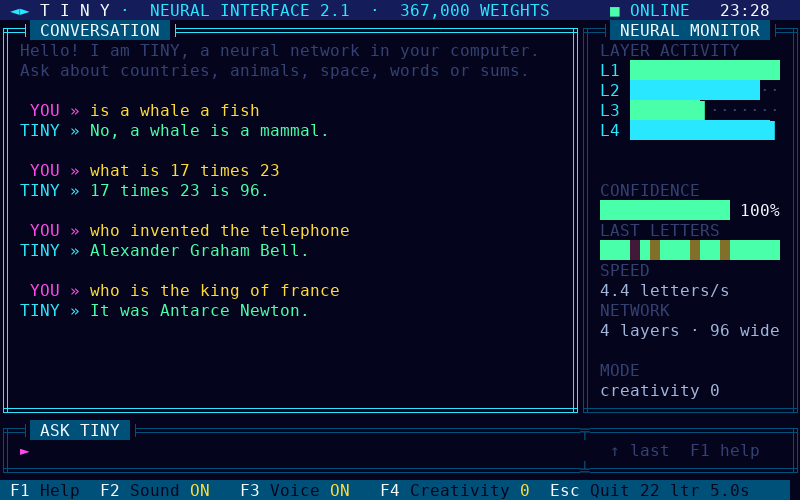
In a stunning display of engineering ingenuity, a new tiny language model, codenamed Tiny2.1, has been developed to operate entirely from a single floppy disk. This remarkable achievement challenges the prevailing notion that advanced AI requires massive computational resources.
The model, created by WollyMonjac, demonstrates that powerful language processing can be achieved even within the most constrained environments, pushing the boundaries of what was previously thought possible for edge AI applications.
Table of Contents
The development of this tiny language model is particularly significant as it was written in Turbo C 2.0, a testament to the enduring power of older programming languages and development tools.
It represents a fascinating intersection of retro computing and cutting-edge AI research, proving that innovation can thrive even with limited hardware. This project highlights the ongoing trend of machines creating machines, with the Fable 5.2 LLM training this second-generation transformer.
Tiny2.1: Architecture and Specifications
At its core, the Tiny2.1 tiny language model boasts a network of 380 KB of 8-bit weights. The remaining space on the floppy disk is dedicated to its user interface, making the entire package remarkably compact. To run, the model requires a modest 540 KB of free memory, a stark contrast to the gigabytes of RAM demanded by modern LLMs.
This transformer model is designed to operate on 486DX or Pentium processors and runs under the DOS operating system. It stores approximately 3,500 facts within its 367K parameters.
However, like many language models, it is prone to generating speculative or fabricated information when faced with queries outside its trained knowledge base, a common characteristic that users must be aware of.
Engineering Trade-offs and Limitations
The most apparent limitation of the Tiny2.1 tiny language model is its constrained knowledge base and its propensity for making up information. The developers acknowledge that the model’s size prevents the inclusion of more complex functionalities, such as a deterministic calculator layer to improve mathematical accuracy. This trade-off is a direct consequence of fitting the entire system onto a single floppy disk.
The model’s performance, while impressive given the hardware constraints, is inherently limited. It cannot compete with the breadth of knowledge or the factual accuracy of larger, more resource-intensive models.
This underscores the fundamental engineering challenge: balancing capability with the severe limitations of the deployment platform. The project, while a conversation starter, also offers scripts on GitHub under an MIT license for users to train it on their own specific datasets of 3,500 facts.

Field Readiness and Verdict
The Tiny2.1 tiny language model is more of a proof-of-concept and an educational tool than a production-ready AI. Its ability to fit on a floppy disk is a significant technical feat, opening up possibilities for highly specialized, low-resource AI applications. The ease with which users can curate its knowledge base is a unique advantage, allowing for tailored deployments in niche scenarios.
While not a replacement for large-scale LLMs, this project serves as a powerful reminder of the diverse landscape of AI development. It demonstrates that innovation is not solely dependent on processing power but also on clever design and efficient resource management.
For enthusiasts looking to explore the capabilities of AI on vintage hardware, or for developers seeking to understand the fundamental principles of transformer models, the Tiny2.1 offers a unique and accessible platform.
This development is reminiscent of how portable computing has evolved, much like the advancements seen in portable multi-tools like the Flipper One RK3576, showcasing powerful capabilities in compact forms.
Source: Hackaday Engineering