
Graperain Unveils Allwinner A733 SoC for Next-Gen Edge AI Applications
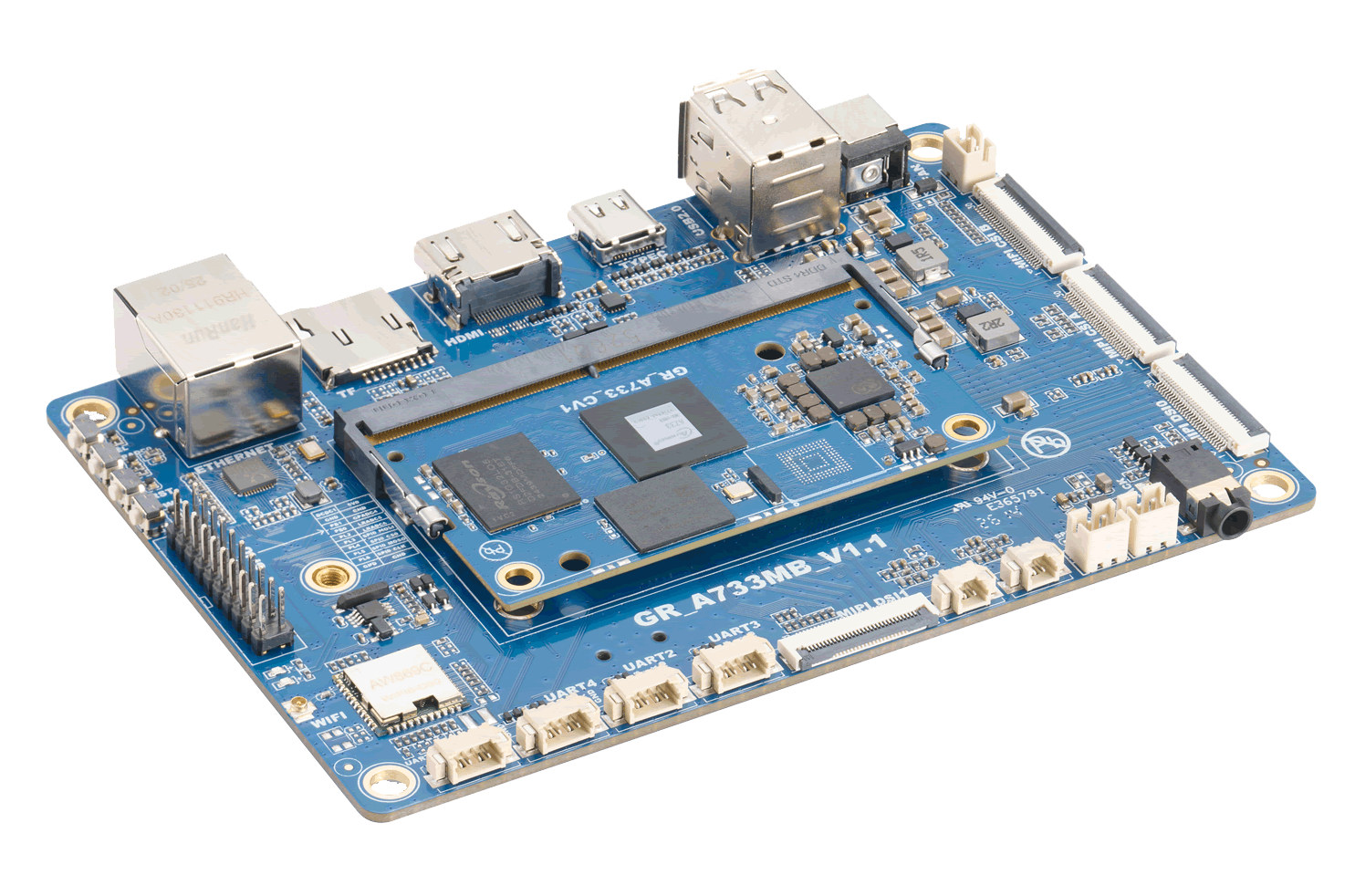
Graperain has officially launched its GR_A733_CV1 system-on-module (SoM) and a corresponding development board, signaling a significant advancement in edge AI capabilities. At the heart of this new offering is the Allwinner A733 SoC, a powerful octa-core processor designed to accelerate artificial intelligence tasks at the edge. This move by Graperain positions them to cater to the growing demand for high-performance, yet power-efficient, embedded AI solutions across various industries.
Table of Contents
The introduction of the Allwinner A733 SoC marks a new era for embedded AI, promising enhanced performance for complex machine learning models directly on devices. This technology is crucial for applications requiring real-time data processing and decision-making without constant cloud connectivity.
Architectural Innovations and Core Specifications
The GR_A733_CV1 SoM is built around the Allwinner A733, a sophisticated System-on-Chip manufactured on a 12nm process. It features a heterogeneous CPU configuration, comprising a dual-core Arm Cortex-A76 cluster clocked up to 2.00 GHz for high-performance tasks and a hexa-core Arm Cortex-A55 cluster running at up to 1.80 GHz for efficiency. Complementing the CPU cores is a single-core RISC-V E902 real-time core, ensuring responsive operation for critical background processes.
Graphics processing is handled by an Imagination Technologies BXM-4-64 MC1 GPU, which boasts robust support for modern graphics APIs including OpenGL ES 3.2, Vulkan 1.3, and OpenCL 3.0. For video processing, the SoC offers advanced decoding capabilities for up to 4Kp60/8Kp24 H.265/VP9/AVS2 and encoding for 4Kp30 H.265/H.264 streams. The standout feature is its integrated 3 TOPS Neural Processing Unit (NPU), specifically designed to accelerate AI workloads.
Memory and storage options are equally impressive, with the SoM supporting up to 16GB of LPDDR5 system memory and up to 256GB of either eMMC flash or UFS 3.0 storage. This combination ensures ample bandwidth and capacity for demanding AI models and datasets. The module connects to a carrier board via a 260-pin SO-DIMM edge connector, facilitating extensive I/O integration.
Development Ecosystem and Connectivity Features
Graperain complements the GR_A733_CV1 SoM with the GR_A733MB-V1.1 carrier and development board. This board significantly expands the usability of the Allwinner A733 SoC, offering a rich array of interfaces. Display outputs include HDMI 2.0b, DisplayPort 1.4 via USB-C, and multiple MIPI DSI and LVDS connectors, supporting resolutions up to 4Kp60. For camera input, the board features two 4-lane and one 2-lane MIPI CSI interfaces, crucial for vision-based AI applications.
Networking capabilities are robust, with Gigabit Ethernet and integrated WiFi 6 with Bluetooth 5.4, ensuring high-speed data transfer and reliable wireless connectivity. The board also provides extensive USB 3.1 Gen 2 and USB 2.0 ports, PCIe 3.0 support, and numerous low-speed I/O options such as UART, TWI/I2C, PWM, and GPIO headers. This comprehensive connectivity suite makes the platform highly adaptable for diverse embedded systems, from industrial automation to intelligent terminals.
Software support is provided for Android 15, Buildroot Linux, and Debian 11, along with a Board Support Package (BSP), Linux kernel, and drivers. While these resources are available to customers, they have not yet been publicly released, indicating a focus on commercial and industrial deployments. This approach is similar to how specialized hardware, like the NXP i.MX 952 SoM, often prioritizes tailored solutions for specific markets.
Engineering Trade-offs and Target Applications
The design of the GR_A733_CV1 SoM and its development board reflects a balance between performance, connectivity, and cost, typical for embedded solutions targeting industrial and commercial markets. The choice of a 12nm process for the Allwinner A733 SoC suggests a focus on achieving a good performance-per-watt ratio, essential for edge devices that may operate on limited power budgets. However, the 3 TOPS NPU, while capable, may present limitations for extremely complex, cutting-edge AI models that require significantly higher computational throughput, such as those found in advanced research or high-fidelity VR environments like those explored in VR gaming.
The operating temperature range of -25°C to +75°C is a critical specification, indicating the hardware’s suitability for demanding industrial environments where temperature fluctuations are common. This robustness is a key consideration for applications in areas like robotics, security equipment, and industrial control systems. The inclusion of multiple camera and display interfaces, alongside high-speed networking, further solidifies its position as a versatile platform for multimedia and IoT applications.
Field Readiness and Market Verdict
Graperain’s new offering, powered by the Allwinner A733 SoC, is poised to make a significant impact in the embedded AI market. Its combination of a powerful heterogeneous CPU, dedicated NPU, ample memory and storage, and extensive I/O makes it a compelling choice for developers creating intelligent edge devices. The target applications span a wide spectrum, including embedded AI, industrial control, intelligent terminals, multimedia systems, robotics, and security equipment.
While Graperain has not publicly disclosed pricing, the availability of such a module and development board underscores the rapid innovation in edge computing hardware. As AI continues to permeate various sectors, solutions like the GR_A733_CV1 will be instrumental in driving the next wave of intelligent, connected devices. The platform’s readiness for demanding tasks, supported by a comprehensive software stack, suggests a strong potential for adoption in commercial and industrial projects seeking a powerful and flexible edge AI solution.
Source: CNX Software Embedded