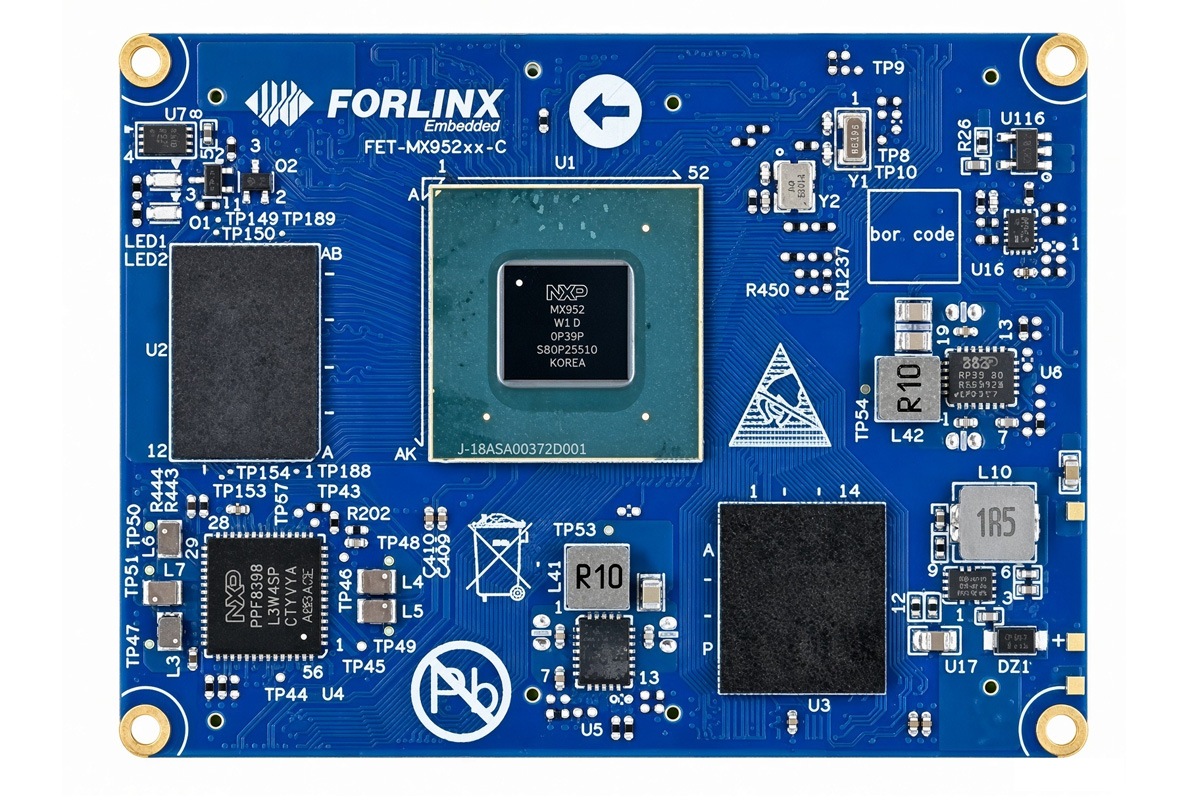
Forlinx FET-MX952x-C SoM: A New Era for Edge AI Unlocked
The Forlinx Embedded FET-MX952x-C System-on-Module (SoM) represents a significant advancement in edge artificial intelligence processing. Built around the powerful NXP i.MX 952 Edge AI SoC, this new module is engineered to meet the demanding requirements of industrial and automotive applications. Its core innovation lies in the integrated 2 eTOPS Neural Processing Unit (NPU), designed to accelerate complex AI workloads directly at the edge.
Table of Contents
This breakthrough technology aims to revolutionize how devices process data locally, reducing latency and enhancing real-time decision-making capabilities. The NXP i.MX 952 SoC itself is a sophisticated piece of silicon, featuring a heterogeneous processing architecture that balances performance and efficiency for embedded systems.
Hardware Architecture and Specifications: Powering Intelligent Systems
At the heart of the Forlinx FET-MX952x-C SoM is the NXP i.MX 952 processor. This SoC boasts a robust core configuration: four Arm Cortex-A55 cores operating at up to 1.7 GHz for general-purpose computing, a dedicated Arm Cortex-M7 real-time core at 800 MHz for time-critical tasks, and an Arm Cortex-M33 safety core at 333 MHz, crucial for functional safety applications. The integrated 2 eTOPS NPU is the standout feature, enabling advanced machine learning inference.
Complementing the SoC, the SoM supports up to 8GB of LPDDR4X RAM and 64GB of eMMC flash storage. Connectivity is a strong suit, with dual Gigabit Ethernet ports offering Time-Sensitive Networking (TSN) support for deterministic communication, essential in industrial automation. Furthermore, the inclusion of three CAN FD interfaces makes it exceptionally well-suited for automotive and industrial control systems. The module also offers PCIe Gen 3 connectivity for further expansion.
The integrated Arm Mali-G310 GPU provides hardware acceleration for graphics, supporting OpenGL ES 3.2, Vulkan 1.2, and OpenCL 3.0. Video processing capabilities include H.264/H.265 hardware decoding up to 4K @ 60fps and H.264 encoding up to 4K @ 30fps. An integrated image signal processor (ISP) further enhances camera applications. The module’s compact 68 × 50 mm dimensions and wide operating temperature range (-40°C to +85°C) underscore its suitability for rugged environments.
Development Ecosystem and Software Support
To facilitate rapid development and evaluation, Forlinx provides the matching OK-MX952x-C development board. This board exposes many of the SoM’s capabilities, including dual Gigabit Ethernet, Wi-Fi, Bluetooth, USB ports, PCIe 3.0, display and camera interfaces, and the critical three CAN FD ports. Optional 4G LTE connectivity is also available via a Mini PCIe slot.
Forlinx offers comprehensive software support, including Linux 6.18, kernel source code, drivers, filesystem images, and hardware documentation. This robust ecosystem aims to streamline the development process, allowing engineers to focus on application-specific innovation. The availability of such resources is critical for projects that need to leverage advanced processing power, similar to how GPU acceleration has transformed data analysis, as seen with solutions like GPU-accelerated DuckDB.
Engineering Trade-offs and Field Readiness
While the Forlinx FET-MX952x-C SoM offers impressive capabilities, potential users should be aware of interface multiplexing. Not all peripherals can be active simultaneously, a common trade-off in high-density embedded modules to manage pin count and complexity. The listed interface specifications represent the maximum hardware support, and careful design is needed to optimize for specific application requirements.
The NXP i.MX 952 SoC also includes NXP’s EdgeLock Secure Enclave and hardware cryptographic features, enhancing security. Its support for functional safety development targeting ISO 26262 ASIL B and IEC 61508 SIL 2 is a critical factor for automotive and industrial applications where reliability and safety are paramount. This focus on safety and security is increasingly important across various tech sectors, from advanced robotics to secure communication systems.
The module’s design prioritizes industrial and automotive use cases, evident in its extended temperature range and robust connectivity options like multiple CAN FD interfaces. This positions it well for applications such as advanced driver-assistance systems (ADAS), industrial robotics, smart factory automation, and intelligent transportation systems. The 2 eTOPS NPU is particularly relevant for real-time object detection and sensor fusion tasks.
Market Positioning and Availability
The Forlinx FET-MX952x-C SoM enters a competitive market for embedded AI processing. It competes with other solutions based on NXP’s i.MX 9 series and similar processors from competitors. Its specific advantage lies in the combination of the i.MX 952’s integrated NPU, comprehensive industrial/automotive interfaces like triple CAN FD, and Forlinx’s supporting development kit and software resources.
Pricing information for the FET-MX952x-C SoM and its development kit is not publicly disclosed, requiring direct contact with Forlinx for quotes. This is typical for specialized industrial hardware, where configurations and volumes significantly impact cost. The company’s previous offerings, like the FET-MX9596-C SoM, highlight their commitment to providing powerful NXP-based solutions, with the new FET-MX952x-C offering a more focused, AI-centric option.
Verdict: A Powerful Edge AI Platform Unlocked
The Forlinx FET-MX952x-C SoM, powered by the NXP i.MX 952, is a compelling solution for developers seeking high-performance edge AI capabilities in industrial and automotive applications. The integrated 2 eTOPS NPU, coupled with robust connectivity and safety features, makes it a versatile platform for next-generation intelligent systems.
Its comprehensive development support and rugged design further enhance its appeal. While potential users need to navigate interface multiplexing and direct sales channels for pricing, the technological advancements unlocked by this SoM are undeniable. It represents a significant step forward in bringing sophisticated AI processing closer to the point of data generation.
Source: CNX Software Embedded