
Pinscope: Next-Gen Embedded Remote Access and Security Unlocked
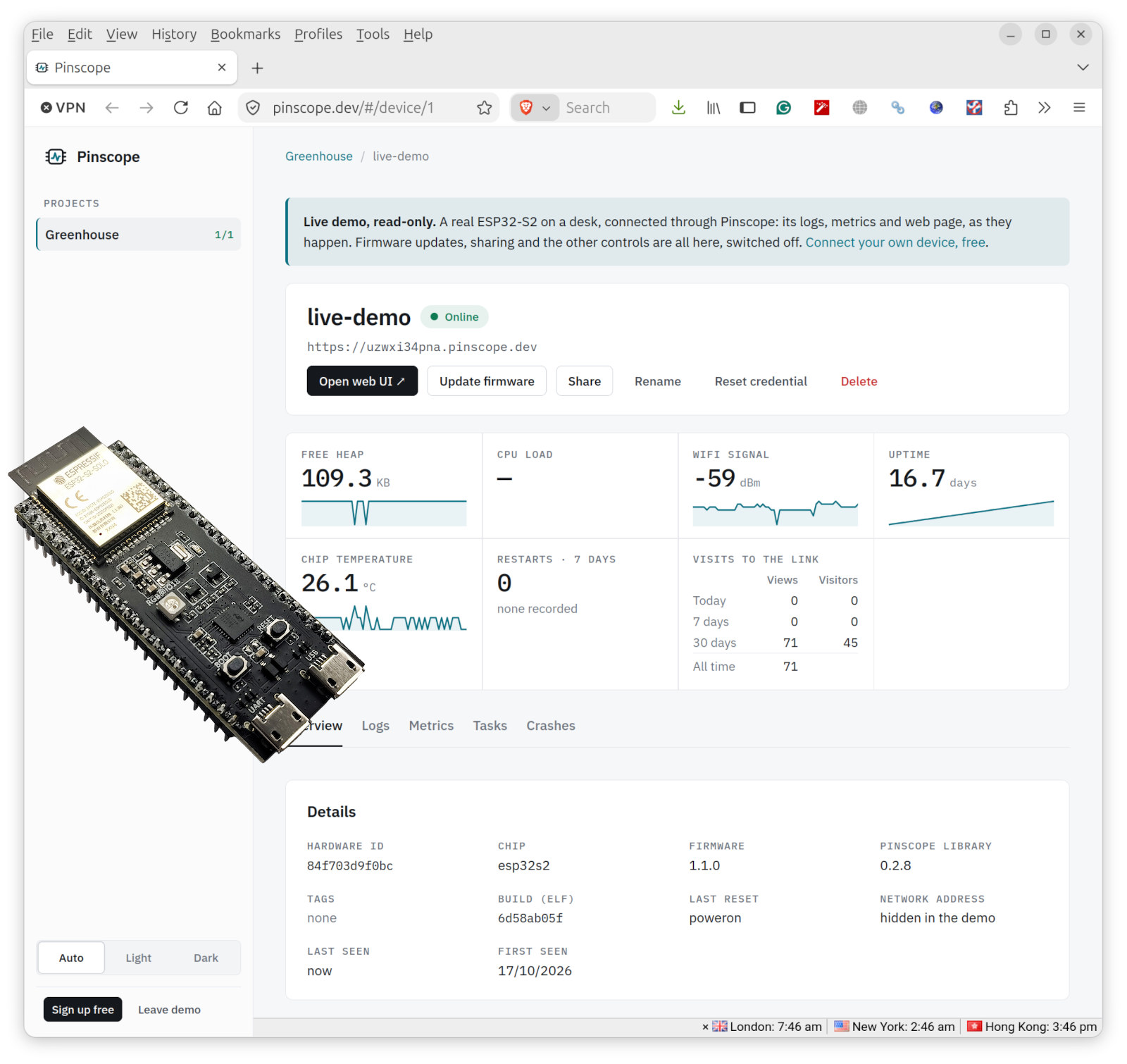
The new Pinscope platform is revolutionizing how developers manage and secure microcontroller-class devices. This innovative web-based solution provides seamless remote access and robust vulnerability tracking for popular platforms including ESP32, ESP8266, Raspberry Pi Pico 2 W, and various MCUs running Zephyr, alongside Linux-based single-board computers like the Raspberry Pi. Pinscope addresses critical needs in the IoT and embedded systems landscape, offering live logs, real-time metrics, and comprehensive crash reporting.
Table of Contents
Its advanced Over-The-Air (OTA) update capabilities include automatic rollback mechanisms in case of failure, ensuring system stability. Furthermore, Pinscope actively tracks Common Vulnerabilities and Exposures (CVEs) for all supported platforms, significantly bolstering the security posture of connected devices.
Web UI and Health Reporting: Enhanced Connectivity and Visibility
Pinscope leverages the existing HTTP server on embedded devices, providing a secure HTTPS address for its web interface. This means pages, APIs, and WebSockets function without modification, accessible through user logins, shareable links, or API tokens. Crucially, this eliminates the need for complex port forwarding or VPN configurations, simplifying remote access for developers.
The platform’s health reporting is equally impressive, offering detailed insights without requiring any code changes. Developers can monitor heap usage, WiFi signal strength, chip temperature, restart reasons, and the free stack space for every task. Custom metrics can be easily integrated with a single function call, providing deep visibility into device performance.
Comprehensive Logging, Crash Analysis, and Secure OTA Updates
Managing logs from various sources like ESP_LOG, Zephyr’s LOG_*, and printf is streamlined with Pinscope. Users can navigate logs by date and time or perform full-text searches across the entire history. In the event of a firmware panic, Pinscope preserves critical information such as the reason, the affected task, and the backtrace, surviving reboots.
This allows engineers to read function names and line numbers after uploading the build’s ELF file, greatly accelerating debugging. The Over-The-Air (OTA) update feature enables one-click deployment to individual devices or entire groups. The process intelligently stops at the first device that encounters an issue, and each device is verified post-update. If a board fails to boot correctly, the bootloader automatically rolls back to the previous stable firmware version, ensuring operational continuity.
Collaboration, EU Cyber Resilience Act Compliance, and Platform Support
Pinscope fosters team collaboration by allowing users to invite colleagues with viewer, member, or administrator roles. It provides an audit trail of actions and offers real-time notifications via email or webhooks for device downtime or crashes. This is crucial for maintaining operational awareness and rapid response.
In line with the EU Cyber Resilience Act, Pinscope imports Software Bill of Materials (SBOMs) for each build. It cross-references these SBOMs daily against the National Vulnerability Database (NVD) and the CISA list of exploited vulnerabilities. The system maintains a VEX-style decision for each CVE, with AI-driven suggestions awaiting engineer confirmation, a significant step towards proactive security management. This proactive approach to security is reminiscent of advancements seen in areas like Zero Trust AI initiatives.
Pinscope supports a wide array of platforms, including Espressif’s ESP32 family (ESP32, S2, S3, C2, C3, C5, C6, C61) with firmware built on ESP-IDF, Arduino, or PlatformIO (requiring ~9.4 KB RAM). It also supports ESP8266 RTOS SDK (~7 KB RAM) and Zephyr RTOS (Beta, ~8.6 KB footprint) for various boards with network connectivity. For Raspberry Pi Pico 2 W (Beta) using Pico SDK with FreeRTOS, it requires ~9 KB footprint. Linux-based systems, including Raspberry Pi and other SBCs, are supported via a lightweight agent for web UI, journal, and health monitoring.
Engineering Trade-offs and Field Readiness
On microcontroller targets, Pinscope’s component integrates securely, utilizing the Noise protocol over a single outbound connection. This design choice, replacing traditional TLS, enables functionality even behind Carrier-Grade NAT (CGNAT) and cellular networks. The footprint is kept minimal, around 9.4 KB of RAM for ESP32 targets.

For Linux systems, a lean agent handles the web UI and log forwarding. A key trade-off is the closed-source nature of the server-side component, although the firmware code for various targets is publicly available on GitHub. The service offers a free tier for up to three devices, with paid plans scaling up to accommodate larger deployments, starting at 9 Euros per month for 10 devices.
The platform’s commitment to security and ease of use is evident. While a live demo offers a read-only experience, the ESP32 demo within the Wokwi simulator provides a hands-on trial requiring a free account. Users should note that browser compatibility was an issue, with Firefox initially causing problems, though this has since been rectified.
Conclusion: A Powerful Tool for Modern Embedded Development
Pinscope presents a compelling solution for developers seeking robust remote access, efficient device management, and proactive security vulnerability tracking. Its comprehensive feature set, broad platform support, and focus on simplifying complex networking challenges make it an invaluable tool for the modern embedded engineer.
The platform’s ability to integrate security compliance, such as adherence to the EU Cyber Resilience Act, directly into the development workflow is a significant advantage. This moves beyond basic functionality, offering a holistic approach to device lifecycle management. For those working with resource-constrained devices or complex network environments, Pinscope unlocks new levels of control and insight, streamlining development cycles and enhancing product reliability.
Source: CNX Software Embedded