AI Breakthrough: Predicting Fine-Tuning Time with 98% Accuracy Unlocks GPU Efficiency
Accurate prediction of AI model fine-tuning duration is critical for efficient GPU cluster management. Traditional FLOPs-based calculations often fall short, leading to significant scheduling inefficiencies and project delays. A new predictive model developed by Dharma AI, detailed in a Hugging Face technical blog, demonstrates a remarkable leap in accuracy, achieving up to 98% precision in estimating end-to-end fine-tuning times.
Table of Contents
This breakthrough in fine-tuning time prediction promises to transform how AI development teams manage their most valuable and scarce computational resources. By moving beyond simplistic theoretical estimates, this approach enables proactive planning, minimizes GPU idle time, and ensures that experiments align with delivery timelines.
Revolutionizing GPU Scheduling with Advanced Predictive Modeling
The core challenge in managing shared GPU clusters lies in accurately estimating job durations. FLOPs calculations, while theoretically sound for compute operations, fail to account for numerous real-world overheads. These include environment setup, data loading, periodic evaluations, checkpointing, and network I/O contention in multi-tenant environments.
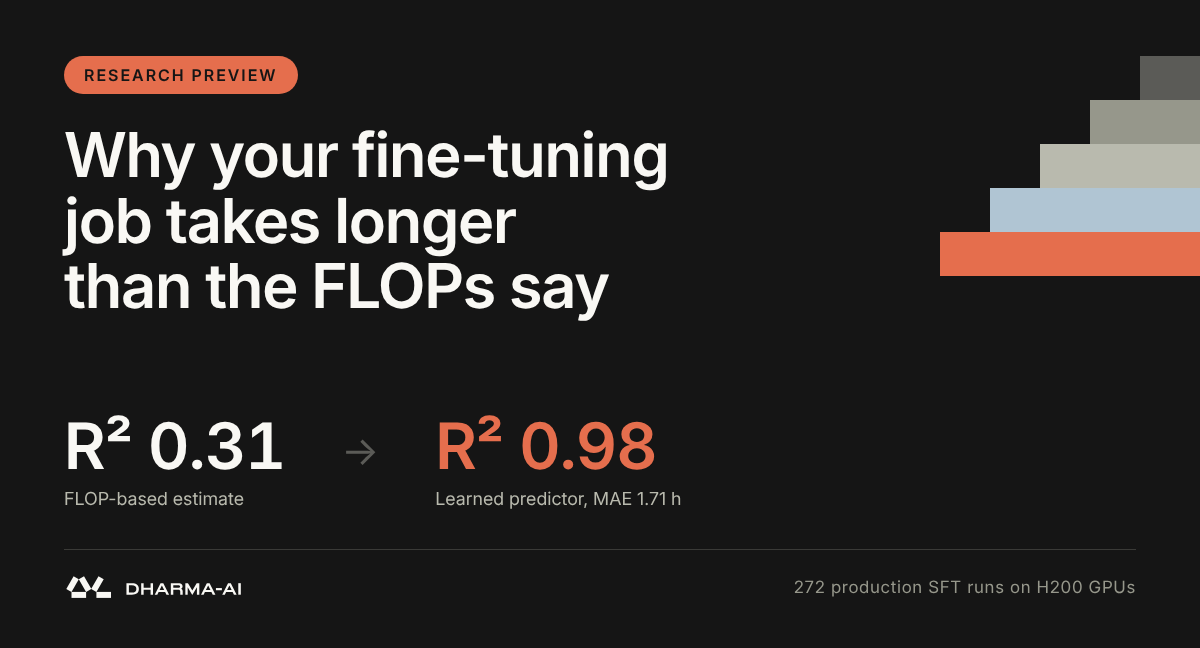
Dharma AI’s research analyzed 272 supervised fine-tuning (SFT) jobs, totaling over 7,382 GPU-hours on NVIDIA H200 GPUs. The study compared traditional FLOPs estimates against a sophisticated CatBoost regressor. The results were stark: FLOPs estimates explained only 31% of the observed variance (R² = 0.31), with a Mean Absolute Error (MAE) of 12.41 hours.
In contrast, the CatBoost model, utilizing only pre-dispatch information, achieved an R² of 0.98 with an MAE of just 1.71 hours and a median error of 0.51 hours. This level of accuracy for fine-tuning time prediction is a game-changer for resource allocation.
The Limitations of Compute-Only Estimates
The theoretical training time is often calculated using the formula: T_theoretical = (6 · P · D) / (N_GPU · FLOPS_peak · MFU). While this formula captures the computational core, it omits critical real-world factors. Model download, environment setup, and final model uploads are significant time sinks.
Furthermore, periodic tasks like evaluations and checkpointing add substantial overhead. These operations, along with network and storage I/O, are highly dependent on job configuration and cluster load. They do not scale linearly with workload, leading to significant deviations from theoretical predictions.
Dharma AI’s Predictive Model: Architecture and Features
The developed model treats end-to-end duration as a supervised regression problem. It takes a feature vector derived from job configuration and model metadata as input, predicting the wall-clock time from GPU allocation to job completion. Crucially, all input features are known before the job is dispatched, making the predictions directly actionable for schedulers.
Key features that enhance the model’s accuracy include metrics related to evaluation cadence, checkpointing frequency, per-GPU load, and fine-tuning regime. Derived quantities such as `num_eval_data`, `num_saves`, and `num_params_saved` provide insights into I/O-intensive operations. The FLOPs estimate itself is included as a baseline feature, allowing the model to learn corrections.
The model was trained using a CatBoost regressor, selected after comparing various algorithms including Linear Regression and XGBoost. Feature selection focused on identifying variables that best capture the overheads influencing actual job duration. This approach ensures that the fine-tuning time prediction is grounded in practical execution realities.
Engineering Trade-offs and Real-World Performance
The predictive model’s performance was rigorously evaluated using 5-fold cross-validation on a diverse dataset of 272 SFT runs. These runs spanned various model families (up to 15 billion parameters), fine-tuning methods (LoRA and full fine-tuning), and dataset sizes, executed on shared NVIDIA H200 infrastructure.
The analysis revealed that even advanced analytical models like Calculon, which account for compute, memory traffic, and inter-device communication, still fall short of capturing the full production job duration. This highlights the significant impact of overheads outside the core optimization loop.
The CatBoost model demonstrated exceptional performance across different job durations. For jobs under 60 hours, the median absolute error remained at or below one hour. While errors increased for very long runs (above 60 hours), this was attributed to a data limitation, with only 13 such runs in the dataset.

Addressing the Long Tail of Job Durations
The model’s accuracy for longer jobs is an area for future improvement. With only a limited number of runs exceeding 60 hours, the model’s ability to generalize to these extreme cases is constrained. The researchers noted that acquiring more data, particularly for extended runs, is expected to further refine the predictions.
The study also identified limitations, including the focus solely on SFT jobs and the use of a single GPU type (H200). Transferring the model’s numerical predictions to different GPU architectures or training objectives would require retraining or adaptation. This is similar to how specialized hardware, like that explored in AI chip design for India, requires tailored software stacks.
Field Readiness and Future Directions
The practical utility of this advanced fine-tuning time prediction model is immense. It provides AI schedulers with reliable duration estimates, enabling optimized job sequencing, better GPU utilization, and improved adherence to project deadlines. This capability is crucial for maintaining agility in fast-paced AI development cycles.
The methodology itself—emphasizing overhead-aware features, robust feature selection, and a rigorous comparison protocol—is transferable. Teams can adapt this pipeline to their own execution log datasets, even with different hardware and software stacks, potentially improving their own scheduling efficiency.
Future work will focus on incorporating hardware-specific descriptors for broader applicability across different GPU types. Expanding the model to cover other training objectives like RLHF and DPO, and collecting more data on long-duration runs, are also key priorities. This ongoing research aims to further solidify the foundation for efficient and predictable AI model training at scale.
Source: Hugging Face Technical Blog
URL: https://huggingface.co/blog/Dharma-AI/predicting-fine-tuning-time