Fraunhofer ADDITIV Pioneers Functional Integration in Additive Manufacturing
Fraunhofer ADDITIV is redefining the possibilities of additive manufacturing by demonstrating novel methods for embedding complex functionalities directly into 3D printed components. At Formnext 2026, the research network showcased a diverse range of technologies spanning metals, polymers, and ceramics, all aimed at consolidating multiple functions into single, intelligently designed parts. This breakthrough in functional integration promises to streamline production, enhance performance, and unlock new applications for 3D printed objects.
Table of Contents
The institute’s exhibits highlighted a significant shift from simply creating shapes to engineering components with inherent capabilities. This approach moves beyond traditional assembly, where multiple parts are required to achieve a desired function. By leveraging advanced materials and sophisticated printing processes, Fraunhofer ADDITIV is enabling the creation of parts that are not only structurally sound but also possess integrated sensing, actuation, or fluidic properties.
Revolutionary Component Design: From Prosthetics to Industrial Tools
Metamaterials Enable Passive Prosthetic Functionality
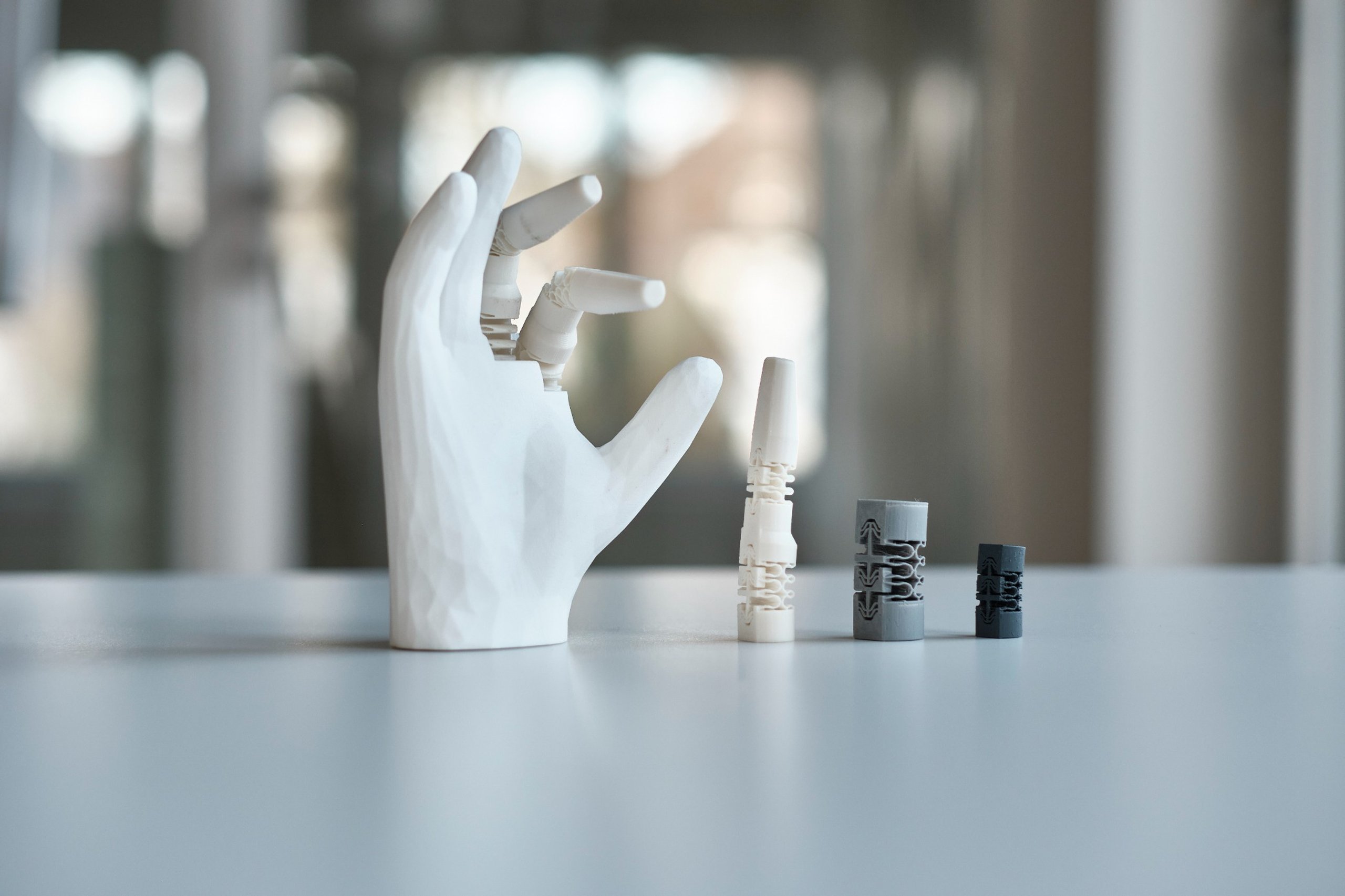
A prime example of this innovative approach is the ProFi finger, developed by Fraunhofer’s Cluster of Excellence for Programmable Materials (CPM). This passive prosthetic finger joint replaces a conventional assembly of multiple parts with a single, additively manufactured component. It utilizes a programmable metamaterial with a bistable structure, allowing it to maintain multiple stable positions without the need for springs, screws, or additional joints.
This consolidation significantly reduces complexity and potential points of failure. The ProFi finger exemplifies how advanced materials can be engineered at the micro-level to achieve macro-level mechanical functions, a core tenet of functional integration in modern engineering.
Integrated Sensing and Fluidics in Metal Components
In the realm of industrial applications, Fraunhofer ILT presented a smart wrench featuring a strain gauge seamlessly integrated into its metal body during powder bed fusion (PBF). This allows for direct measurement of loads and real-time monitoring of industrial components, enhancing predictive maintenance and operational safety. This represents a significant leap in functional integration for tooling.
Furthermore, Fraunhofer ILT demonstrated the creation of porous titanium structures for electrolyzer cells using laser powder bed fusion (LPBF). These single printed components combine essential functions such as water supply, gas removal, electrical conductivity, and mechanical stability. This eliminates the need for separate manifold systems and complex assembly, streamlining the production of critical energy components.
Advanced Thermal Management and Material Science Innovations
High-Performance Heat Pipes and Diamond Composites
Thermal management was another key focus, with Fraunhofer IWU and Fraunhofer IPM developing 3D printed copper pulsating heat pipes. These innovative devices demonstrated impressive thermal dissipation capabilities, managing approximately 1,200 W from small, postcard-sized demonstrators. Their compact design and high efficiency are crucial for thermal control in densely packed electronic systems, similar to the challenges addressed by advanced cooling solutions in high-performance computing.
Fraunhofer IKTS explored thermal conductivity from a different angle, producing additively manufactured diamond composites. These materials not only offer exceptional wear resistance but can also be formed into complex geometries, making them ideal for advanced heat exchangers and thermal management applications where traditional manufacturing methods fall short.
Functionally Graded Materials for Extreme Environments
Material accessibility and performance under extreme conditions were also addressed. Fraunhofer IGCV is developing functionally graded tungsten-copper composites designed for the harsh environments of future fusion reactors. While specific performance data is pending, the focus on creating materials with tailored properties for specific zones within a component is a testament to the advanced state of functional integration research.
Fraunhofer IFAM is advancing the use of sinter-based additive processes for nickel-based superalloys. These materials are notoriously difficult to process with laser-based methods due to cracking and residual stress issues. The sinter route circumvents these challenges, opening up additive manufacturing possibilities for these high-performance alloys.
Process Enhancements and Digital Workflow Integration
Accelerated Deposition and Efficient Coating Technologies
On the process side, Fraunhofer ILT introduced a patented Fluidic Powder Switch for laser metal deposition (LMD) and EHLA processes. This system controls powder flow without mechanical wear, achieving deposition speeds up to 20 times faster than conventional mechanical systems. This significant speed increase is critical for scaling up additive manufacturing for industrial production, impacting areas like the rapid manufacturing of large components, akin to the efficiency gains seen in advanced material handlers like the Mantsinen 200 Material Handler.
Fraunhofer IWS presented Laser Direct Plating, a technology for coating rotationally symmetric components that can reduce energy consumption by up to 90%. While these figures represent optimal conditions, they highlight the potential for substantial efficiency gains in surface treatment processes.
Advanced Polymers and Seals for Diverse Applications
In polymer applications, Fraunhofer IAP showcased additively manufactured hinges from shape-memory polymers, designed for deploying satellite solar panels. Fraunhofer IPA demonstrated the tool-free production of EPDM seals and complex sealing geometries printed directly onto existing components, offering a flexible and efficient solution for sealing applications.
Digital Tools Connect Design, Process, and Quality Assurance
Comprehensive Software for Multimaterial Printing and Inspection
The integration of digital tools is crucial for realizing the full potential of these advanced manufacturing techniques. Fraunhofer IGD’s Cuttlefish platform supports multimaterial 3D printing, offering capabilities in color and translucency reproduction, virtual print previews, and data-driven design for prosthetics. This level of digital control is essential for achieving precise functional integration.
Fraunhofer IWM’s FlowBoard provides optical analysis of powder flow behavior, while Fraunhofer IMTE uses computed tomography for non-destructive inspection of dimensional accuracy and internal defects. These tools collectively bridge simulation-driven design, process development, and quality assurance into a unified workflow, ensuring reliability and performance.
Industry Readiness and Future Outlook
Fraunhofer ADDITIV also announced the upcoming Direct Digital Manufacturing Conference (DDMC) 2027, signaling continued commitment to advancing the field. The focus on functional integration across diverse materials and processes positions Fraunhofer at the forefront of additive manufacturing innovation.
The ability to build complex functionalities directly into parts represents a paradigm shift. It reduces part count, simplifies assembly, enhances performance, and opens doors to entirely new product designs. As these technologies mature, we can expect to see widespread adoption in sectors ranging from aerospace and automotive to medical devices and consumer electronics, driving efficiency and innovation.
Source: 3D Printing Industry