The Hough Transform: Unlocking Machine Perception
The Hough Transform is a fundamental technique that empowers computers to perceive and interpret visual information, a capability crucial for modern artificial cognition systems. Developed in the 1960s, this algorithm allows machines to detect shapes, most notably lines, within images. Its enduring relevance highlights the ingenious solutions required to bridge the gap between raw pixel data and meaningful scene understanding.
Table of Contents
The journey of computer vision from rudimentary pattern matching to sophisticated scene analysis is a testament to algorithmic innovation. Early pioneers sought ways to imbue machines with a semblance of sight, a task that mirrors the complex biological processes of animal vision. The Hough Transform emerged as a pivotal development in this quest, providing a robust method for feature extraction.
From Bubble Chambers to Autonomous Systems
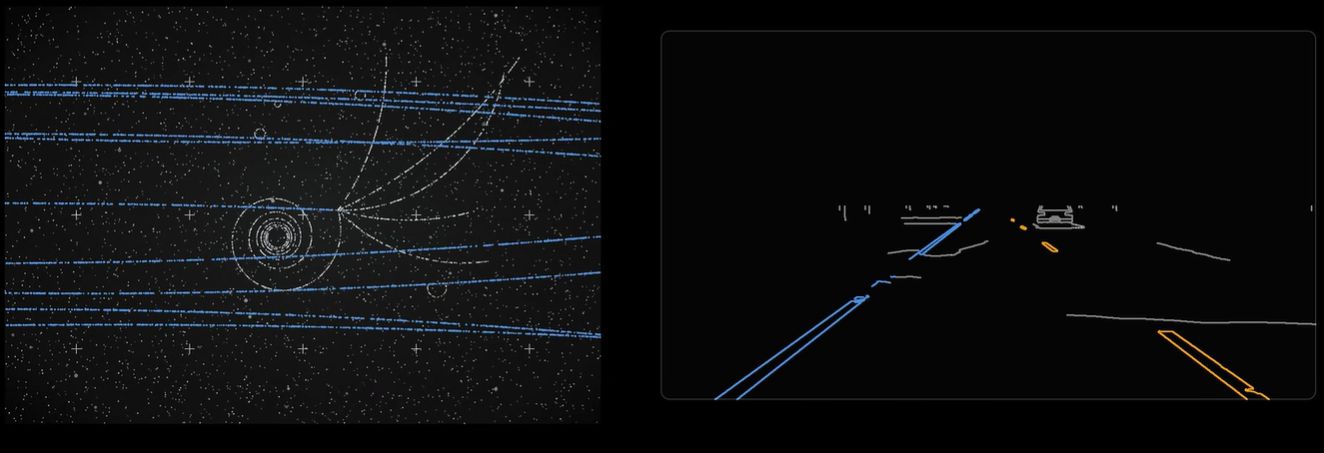
Originally conceived by Paul Hough, the algorithm’s initial application was analyzing patterns in bubble chamber photographs, a task involving the detection of particle tracks. These tracks, appearing as straight lines, were precisely what the Hough Transform was designed to identify. This foundational work laid the groundwork for more complex applications across various fields.
The core principle involves transforming image points into a parameter space, where shapes like lines can be detected more easily. While the original algorithm was computationally intensive, subsequent optimizations have made it practical for real-time applications. This evolution is key to its widespread adoption in fields requiring precise visual analysis.
Architectural Foundations and Algorithmic Evolution
At its heart, the Hough Transform operates by converting edge points detected in an image into potential shape parameters. For line detection, each edge point is mapped to a sinusoidal curve in a parameter space (often referred to as the Hough space). Points that lie on the same curve in this space correspond to collinear points in the original image, indicating a detected line.
The process typically begins with edge detection, such as using the Canny edge detector, to identify significant boundaries within an image. These edge pixels are then transformed into the Hough parameter space. Accumulator arrays are used to count the votes for each potential line parameter, with peaks in the accumulator indicating the presence and parameters of lines in the image.
Optimizations for Real-World Complexity
Real-world scenes present significant challenges due to noise, occlusions, and variations in lighting. The naive Hough Transform can be slow and sensitive to noise. To address this, researchers developed optimized versions, including probabilistic Hough Transforms and generalized Hough Transforms, which can detect not only lines but also arbitrary shapes.
These optimizations reduce computational load and improve robustness. For instance, the probabilistic Hough Transform randomly samples edge points, making it faster for large images. The generalized Hough Transform extends the concept to detect any shape for which a template can be defined, a significant leap for pattern recognition.
Engineering Trade-offs and Algorithmic Limitations
Despite its power, the Hough Transform is not without its limitations. The primary trade-off lies between accuracy and computational cost. Higher resolution images and the need to detect finer details increase the dimensionality of the parameter space, leading to significantly longer processing times.
Memory usage can also be a concern, especially when dealing with high-dimensional parameter spaces or complex shapes. Furthermore, the algorithm’s performance can degrade in the presence of significant image noise or when objects are heavily occluded, making it challenging to reliably extract features.
Handling Noise and Ambiguity
Dealing with pixel noise is a critical engineering challenge. While edge detection pre-processing helps, spurious edge points can still lead to false positives in the Hough space. Careful parameter tuning, such as setting appropriate thresholds for line detection, is essential to mitigate these issues.
The ambiguity of certain shapes in parameter space can also lead to misinterpretations. For example, very short lines or lines that are nearly parallel might be difficult to distinguish reliably without additional contextual information or more advanced algorithms. This is where integrating other sensors, like Lidar or radar, becomes crucial for systems such as autonomous vehicles.
Field Readiness and Future Verdict
The Hough Transform remains a cornerstone of computer vision, particularly in applications where precise geometric feature detection is paramount. Its robustness and adaptability have ensured its continued relevance in fields ranging from robotics and autonomous driving to medical imaging and industrial inspection.
The ongoing advancements in hardware, such as specialized AI accelerators, and algorithmic refinements continue to push the boundaries of what’s possible. As we move towards more sophisticated AI, techniques like the Hough Transform, which provide reliable foundational perception, will be indispensable. Its legacy is not just in detecting lines, but in enabling machines to truly begin to ‘see’ and interact with the world.
The integration of such algorithms into edge AI systems, like those used in agriculture for smarter field intelligence, demonstrates its practical impact. Even in areas like 3D printing, understanding geometric shapes is critical for production, showing the broad applicability of these core computer vision principles.
Source: Hackaday Engineering
hackaday.com