
The 20-Cent Single-Chip USB GPU: A Graphics Breakthrough
The concept of a single-chip USB GPU, while seemingly ambitious, has been realized in a remarkable project by [bitluni]. This innovative design leverages a single microcontroller to generate analog video signals, effectively creating a functional, albeit basic, graphics processing unit. This development challenges conventional notions of GPU complexity and cost, demonstrating that essential graphics capabilities can be achieved with minimal hardware.
Table of Contents
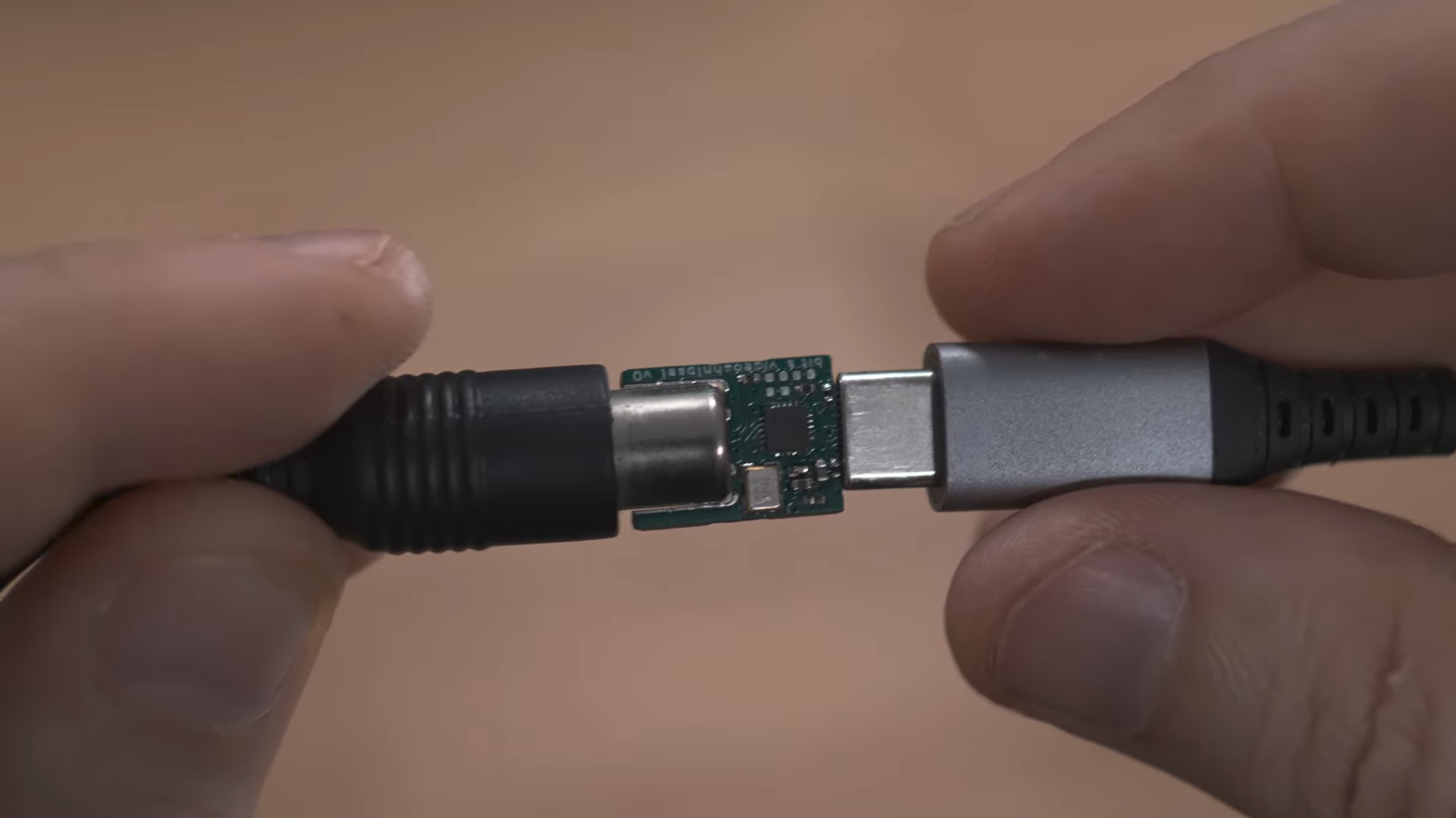
The core of this project is the CH570 microcontroller, a remarkably capable chip that handles all active processing. Integrated onto a single, compact PCB, the design eschews traditional components for a minimalist approach. Even the USB-C connector is constructed directly from the PCB material, showcasing an impressive level of integration and design ingenuity.
Hardware and Software Architecture
The physical implementation of the single-chip USB GPU is as ingenious as its concept. The device utilizes a PCB-based USB-C connector and even integrates the analog RCA connector through specially designed copper cutouts. This allows the PCB itself to plug directly into a female RCA port, though a slight sensitivity to orientation has been noted due to variations in RCA port construction.
Timing is paramount for video signal generation, and a crystal oscillator is crucial for maintaining synchronization with the display’s refresh rate. To meet these high-speed demands, all critical operations are performed using the microcontroller’s SRAM. An initial performance anomaly was traced back to the compiler inadvertently utilizing flash memory, highlighting the importance of precise memory management in such constrained environments.
The analog video signal is generated using Pulse Width Modulation (PWM). Functionally, the device presents itself as a USB CDC (Communication Device Class) device, enabling it to display grayscale text and rudimentary graphics. [bitluni] has developed a program that utilizes this capability as a serial terminal, proving its practical application.
Engineering Trade-offs and Limitations
The primary constraint in developing this single-chip USB GPU is achieving the necessary timing for video output. The reliance on a single microcontroller necessitates careful optimization of every process. The performance drop observed due to flash memory usage underscores the critical trade-off between component cost and processing efficiency.
While the current iteration supports grayscale text and basic graphics, the potential for color output exists. By employing SPI communication and overclocking the microcontroller, [bitluni] theorizes the possibility of transmitting a PAL color signal. This exploration into advanced transmission methods, similar to how custom firmware can unlock new features in devices like the CMU200, highlights the ongoing drive for enhanced functionality in embedded systems.
The project’s success in generating a video signal from such a low-cost component is significant. However, it’s important to manage expectations regarding performance. This is not a replacement for modern GPUs used in gaming or complex visual applications. Instead, it serves as a proof-of-concept for ultra-low-cost display solutions, potentially useful in niche embedded applications or educational contexts.

Field Readiness and Verdict
The single-chip USB GPU project stands as a testament to the power of minimalist design and clever engineering. Its ability to output video signals using a microcontroller costing mere cents is a remarkable achievement. The device’s functionality as a serial terminal demonstrates immediate practical value, and the potential for future enhancements, such as color output, is intriguing.
While not suitable for demanding graphical tasks, this project opens doors for applications where basic visual feedback is required at an extremely low cost. It echoes the spirit of innovation seen in other embedded projects, such as the ESP32-S3 controller enabling smart swimming pool automation. The low barrier to entry makes it an attractive project for hobbyists and engineers looking to explore video generation from unconventional sources.
In conclusion, [bitluni]’s single-chip USB GPU is a significant engineering feat. It proves that with ingenuity, even the most basic microcontrollers can be repurposed for complex tasks like video generation, pushing the boundaries of what’s possible in embedded graphics.
Source: Hackaday Engineering