
Supermicro SYS-E103-14P-H: A Compact Fanless Edge Appliance Breakthrough
The Supermicro SYS-E103-14P-H emerges as a compelling solution for edge computing, integrating Intel’s latest Panther Lake architecture into a dense, fanless form factor. This appliance is engineered for demanding industrial environments, offering a potent combination of processing power and versatile I/O. Its fanless design is a critical advantage, ensuring silent operation and enhanced reliability in dusty or temperature-sensitive locations. The inclusion of the Intel Core Ultra X7 368H processor signifies a leap in performance for such compact systems.
Table of Contents
Hardware Architecture and Dense I/O Capabilities
At the heart of the SYS-E103-14P-H lies the Intel Core Ultra X7 368H processor, a 16-core chip featuring a heterogeneous design with Performance-cores, Efficient-cores, and Low Power Efficient-cores. This processor is complemented by 32GB of DDR5-5600 SODIMM memory, allowing for user upgrades, and a PCIe Gen5 x4 M.2 slot for fast storage. The system also includes an additional M.2 slot for further expansion, alongside an empty M.2 E-key slot ready for wireless modules.
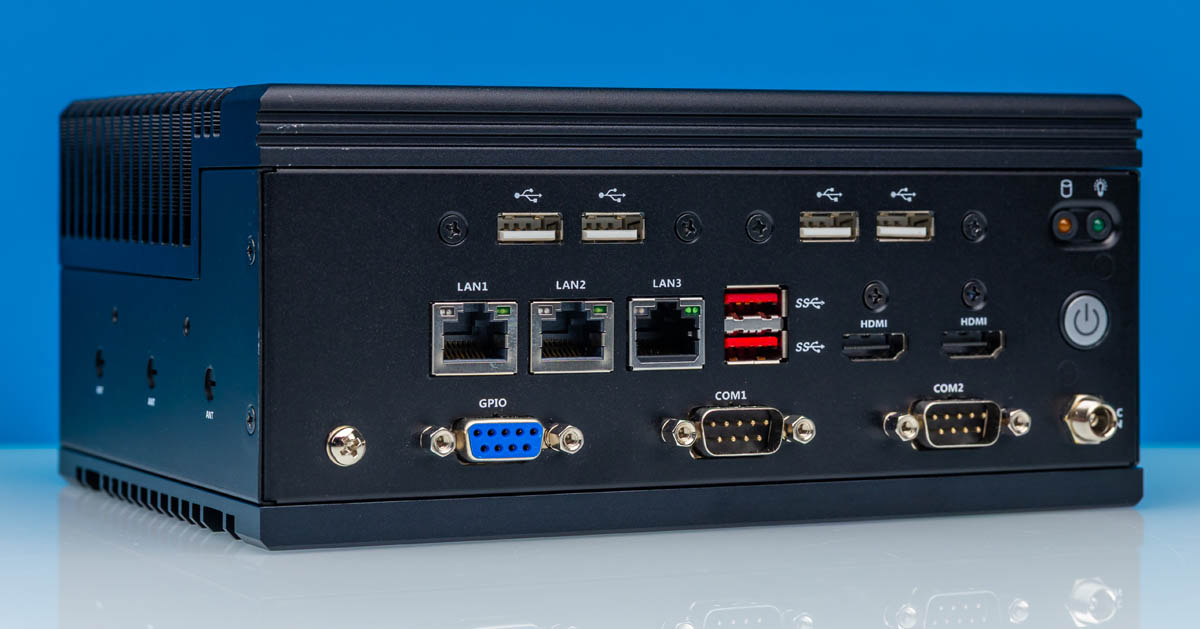
The external connectivity is remarkably dense, with a focus on industrial needs. The front panel boasts two 2.5GbE LAN ports powered by Intel I226-IT controllers and a single 1GbE port from an Intel I219-LM controller, which notably supports Intel vPro management. This provides robust networking options, essential for edge deployments. Additionally, the front offers two USB 3.2 Gen2 Type-A ports for high-speed peripherals and four USB 2.0 Type-A ports for legacy devices and dongles.
Further enhancing its industrial appeal are two COM ports (RS-232/422/485) and a DB9 GPIO connector, enabling seamless integration with existing industrial equipment. Dual HDMI 2.1 ports provide support for high-resolution displays, leveraging the integrated Intel Arc B390 GPU. The system accepts a wide-range DC input (12V-36V) via a locking connector, ensuring stable power delivery in varied environments. This fanless edge appliance is designed for resilience.
Engineering Trade-offs and Fanless Design Considerations
The primary engineering trade-off for the SYS-E103-14P-H is its reliance on passive cooling. The chassis itself acts as a heatsink, featuring pronounced fins on the top and bottom surfaces to maximize heat dissipation. While this eliminates fan noise and potential failure points, it inherently limits the sustained thermal envelope compared to actively cooled systems. For continuous high-load operations, especially in warmer ambient temperatures, careful thermal management and workload planning are crucial.
The distribution of I/O between the front and rear panels is a deliberate design choice for industrial applications. Placing most connectivity on the front simplifies cabling and maintenance in rack-mounted or confined spaces. However, the lack of internal IPMI means that remote management relies on Intel vPro capabilities through the 1GbE port, which may not be sufficient for all IT management scenarios. The inclusion of USB 2.0 ports, while practical for low-bandwidth peripherals, might be a limitation for users requiring faster data transfer for certain edge devices.

Field Readiness and Verdict on the Fanless Edge Appliance
Supermicro’s SYS-E103-14P-H is a well-executed fanless edge appliance tailored for industrial and embedded applications. Its robust build, comprehensive I/O, and the power of the Intel Core Ultra processor make it a versatile platform. The fanless design enhances reliability, a key factor for edge deployments where maintenance can be challenging. This appliance is particularly suited for scenarios like IoT gateways, digital signage, or industrial automation where silent, consistent operation is paramount.
While the passive cooling requires consideration for sustained high-performance tasks, the overall package offers significant value. The ability to integrate wireless modules and the wide DC input range further underscore its suitability for diverse field deployments. For organizations seeking a compact, reliable, and powerful edge computing solution, the Supermicro SYS-E103-14P-H presents a strong option, demonstrating how modern processors can be harnessed in fanless designs. This aligns with the growing trend of powerful computing moving closer to data sources, much like advancements seen in areas such as AI acceleration with technologies like NVIDIA cuDSS.
Source: ServeTheHome Enterprise Hardware