
Linux in browser: A New Frontier for Portable Computing
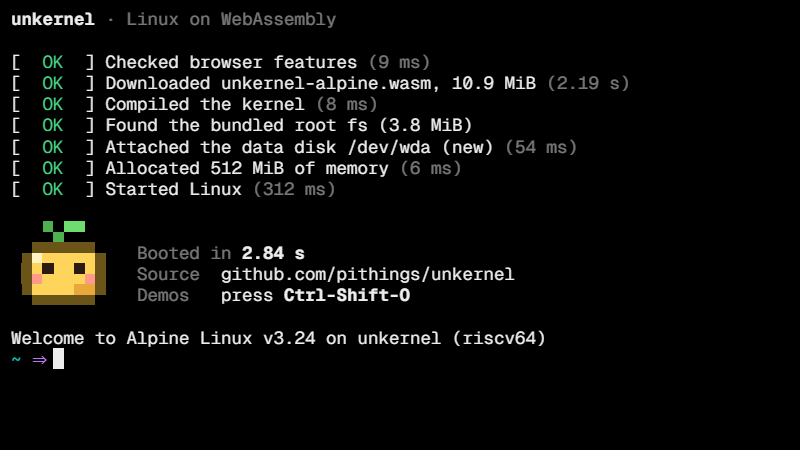
The concept of running a full Linux kernel directly within a web browser tab has transitioned from a distant possibility to a tangible reality. This groundbreaking achievement is made possible by Unkernel, a project that compiles the Linux 7.x kernel into a single WebAssembly (WASM) module.
This innovative approach allows users to access a functional Linux environment without traditional installation, marking a significant step in accessible computing.
Table of Contents
Unkernel leverages the power of WebAssembly to bring essential kernel functionalities, including system calls, scheduling, memory management, file systems, and networking, into the browser.
User programs are emulated using a just-in-time compiler, enabling compatibility with popular distributions like Ubuntu and Alpine packages. The result is a complete Linux experience, complete with a shell, package manager, persistent storage, sound, and internet access, all contained within a single browser tab.
Unkernel’s Architecture and Software Stack
At its core, Unkernel is an ambitious engineering feat that reconstructs the Linux kernel as a self-contained WebAssembly module. This module includes a Memory Management Unit (MMU), crucial for modern operating systems.
The compilation process targets WASM, a low-level binary instruction format designed for efficient execution in web browsers and other environments.
The system emulates user programs through a just-in-time (JIT) compiler. This allows for the execution of standard Linux binaries and packages, such as those found in Ubuntu or Alpine Linux distributions.
The inclusion of a shell, package manager, and persistent storage means users can interact with the system much like a traditional Linux installation, albeit within the confines of the browser environment.
The project’s success in integrating networking and sound further enhances its utility. This comprehensive feature set makes the Linux in browser capability offered by Unkernel surprisingly robust for on-the-go tasks or development environments where installing a full OS is impractical.
For those interested in portable Linux solutions, the Flipper One RK3576, an 8GB Linux portable multi-tool, represents another avenue for on-the-go Linux computing, albeit through dedicated hardware.
Engineering Trade-offs and Performance Limitations
While Unkernel offers unprecedented accessibility, it is not without its performance trade-offs. Running a full operating system kernel within a browser sandbox, even with WebAssembly’s efficiency, inevitably introduces overhead compared to native execution.
Benchmarks using tools like OpenSSL speed indicate that Unkernel can be significantly slower than a native Linux installation, with some tests showing it to be 6 to 7 times slower.
The performance can vary depending on the browser and the underlying hardware. For instance, the QEMU emulation demo within Unkernel has shown considerably slower performance on Chromium compared to Firefox.
This suggests that the JIT compiler and the WASM runtime’s efficiency play a critical role in the overall user experience. While the goal is a “decent fraction of native speed,” practical applications requiring high performance may find these limitations challenging.
The potential for enhanced functionality, such as mounting host directories via the Filesystem API, could significantly improve usability, especially in restricted corporate environments.
However, the current performance metrics suggest that Unkernel is best suited for tasks where convenience and portability outweigh raw speed requirements. This contrasts with dedicated hardware solutions like the Flipper One RK3576, which offers native performance for its specific multi-tool functions.

Field Readiness and Future Verdict on Linux in Browser
Unkernel represents a fascinating proof-of-concept for the future of operating systems and web technologies. The ability to run a Linux in browser environment opens up numerous possibilities for education, development, and quick access to a familiar computing platform.
Its portability makes it an attractive option for users who need a Linux shell or specific tools without the commitment of a full OS installation.
However, the current performance limitations mean that Unkernel is unlikely to replace native Linux installations for demanding tasks or production environments in the immediate future.
It excels as a supplementary tool, offering a convenient way to test code, access command-line utilities, or explore Linux distributions on any device with a modern web browser. The ongoing development of WebAssembly and browser runtimes may further enhance its speed and capabilities over time.
The project’s success highlights the rapid evolution of web technologies, pushing the boundaries of what can be achieved directly within a browser. While the days of Linux CDs bundled with magazines are long gone, Unkernel offers a modern, digital equivalent, bringing the power of Linux to a universally accessible platform.
For those seeking robust, native Linux experiences, dedicated hardware or traditional installations remain the preferred choice, but for accessible, on-demand Linux, Unkernel is a compelling innovation.
The evolution of operating systems and their accessibility is a constant theme in technology. While Unkernel focuses on bringing Linux to the browser, other advancements, like the increasing efficiency of electric vehicles such as the Greenworks OPTIMUS UTV, showcase progress in different technological domains. The core principle remains the same: pushing boundaries and unlocking new capabilities through innovative engineering.
Source: Hackaday Engineering
