The Lag Effect: Trucking Capacity Declines Amidst Rate Recovery
The trucking industry is experiencing a significant shift, characterized by a sharp decline in available capacity coinciding with a robust recovery in freight rates. SONAR’s latest report, “The Lag Effect,” details how truckload rates have now surpassed the cost of operating a truck, a reversal after three years of erosion. This dynamic has led to an unprecedented exodus of carriers, with capacity leaving the market at a record pace. Contract rates are also showing upward momentum, indicating further adjustments for shippers in their 2027 bidding strategies.
Table of Contents
This situation presents a complex scenario where rising operational costs, particularly for fuel, are being outpaced by surging spot and contract rates. The report highlights that while industry non-fuel operating costs have risen modestly, truckload rates have surged dramatically. This disparity is forcing many smaller, spot-dependent carriers out of business, even as the market begins to recover, underscoring the precarious financial positions many operated under during the downturn.
Carrier Costs vs. Market Rates: A New Equilibrium
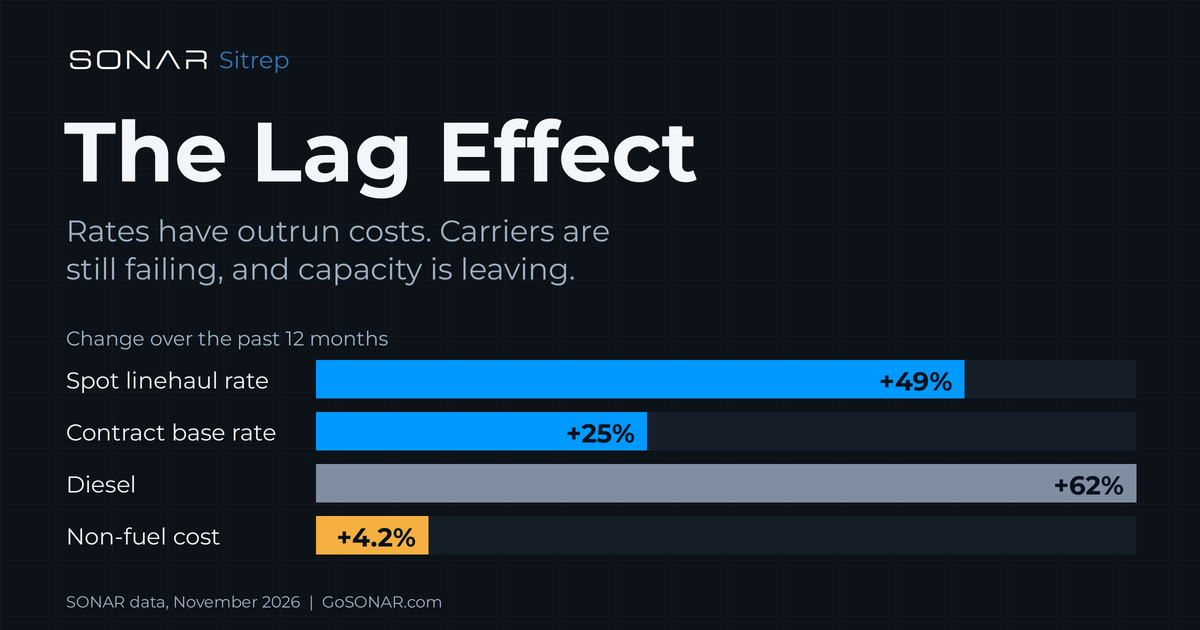
For the first time in three years, truckload rates are exceeding the non-fuel operating costs for carriers. The SONAR National Truckload Index (NTIL) for spot linehaul has reached $2.60 per mile, approximately $0.75 above the estimated 2025 industry non-fuel cost of $1.854 per mile. This marks a significant turnaround from 2023-2025, when spot linehaul rates consistently fell below these essential operational expenses.
Dry van contract base rates (VCRPM1) have also seen substantial growth, climbing about 25% year-over-year to $2.88 per mile. However, the cost of diesel fuel has significantly impacted profitability, with prices up about 62% to $6.15 per gallon, adding roughly $0.36 per mile in fuel expenses. This increase in fuel costs, coupled with a 4.2% rise in other non-fuel operating costs, means that while rates are recovering, the margin for many carriers remains tight.
Unprecedented Capacity Reduction in the Trucking Sector
The most striking finding from SONAR’s analysis is the dramatic and record-breaking decline in trucking capacity. The number of tractors in for-hire fleets has fallen by approximately 107,000 from the previous year, with an astonishing 51,000 tractors removed in a single month this past summer. This represents the largest decrease in fleet capacity since SONAR’s data series began in 2008.
This capacity crunch is further evidenced by soaring tender rejection rates. The SONAR Truckload Rejection Index (STRI) has doubled year-over-year to 12.87%, more than tripling its October 2023 level. This indicates that carriers are increasingly turning down contracted loads, opting for more lucrative spot market opportunities. Truckload volume, meanwhile, remains relatively stable, suggesting fewer trucks are competing for a similar amount of freight, intensifying the capacity squeeze.
Regional Disparities and Equipment-Specific Tightness
While the national average points to a tight market, significant regional variations exist. The Northwest and Midwest regions are experiencing particularly high tender rejection rates, exceeding 23% and 17% respectively, far above the national average. Conversely, many major Sun Belt markets, including Atlanta, Dallas, and Houston, remain relatively loose, with rejection rates below 8%.

This market tightness is also evident across different equipment types. Reefer (STRIR) and flatbed (STRIF) rejection rates are both above 21%, with spot rates for these segments up approximately 50%. This suggests that specialized equipment and routes are facing the most intense capacity constraints, a trend that could influence future investments in areas like electric freight trucks, as interest surges with diesel price volatility. Electric freight trucks are seeing renewed interest due to the significant diesel price surge.
Outlook for 2027: Shippers Brace for Higher Contract Rates
Shippers preparing for 2027 contract bids should anticipate further rate increases. Dry van contract base rates are still estimated to be about 6.5% below the level required to fully cover carrier overhead. The gap between spot and contract rates has narrowed considerably, falling from $0.57 to $0.28 per mile over the past year.
The SONAR report’s base case scenario projects dry van contract rate increases of 5% to 8%, with the potential for double-digit hikes if capacity continues to exit the market at the current pace. Reefer contract rates, which have seen more modest increases of around 8%, have the most significant room for upward adjustment, currently sitting about $0.30 per mile below dry van contract rates. Shippers are advised to meticulously price their routing guides on a lane-by-lane basis rather than relying solely on national index averages to navigate these evolving market conditions.
Source: FreightWaves Supply Chain Tech