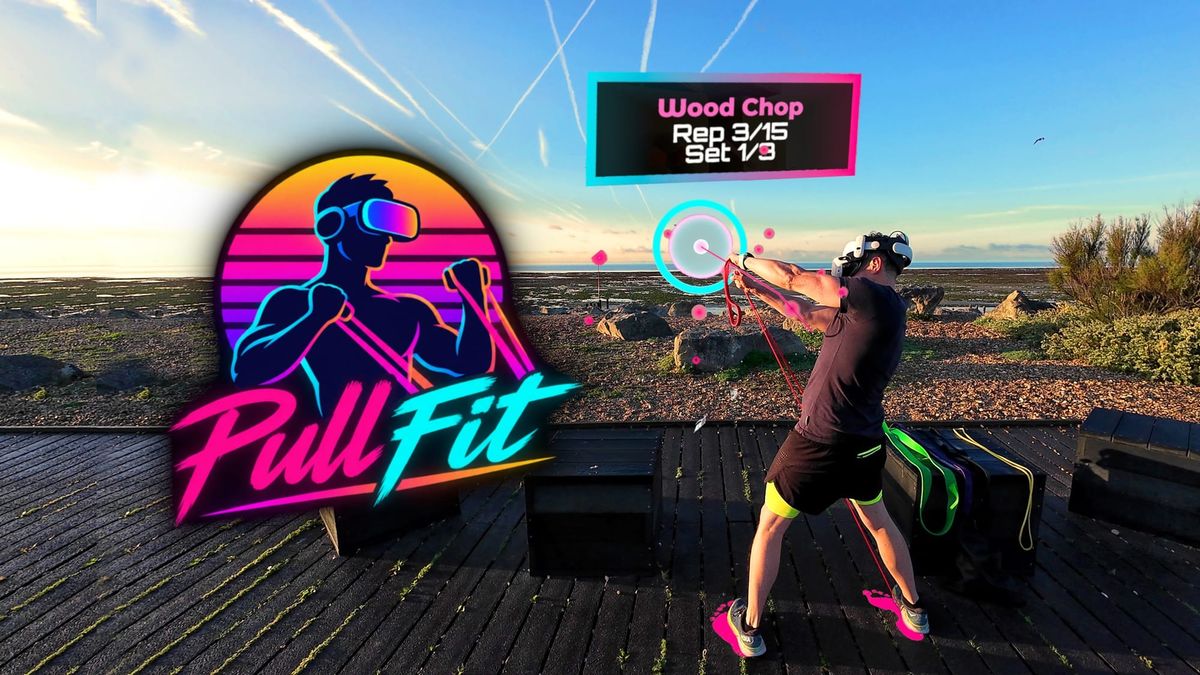
PullFit Emerges as a Breakthrough in VR Resistance Training
The landscape of virtual reality fitness is expanding with the introduction of PullFit, a new application that brings the benefits of resistance training directly to Meta Quest users. This innovative app, now available in Early Access, addresses a growing demand for comprehensive fitness solutions within VR. PullFit aims to bridge the gap between cardio-focused VR experiences and the essential component of strength building, offering a unique and accessible approach.
Table of Contents
Developer James Hough recognized a gap in the market for a VR fitness application that incorporated external resistance equipment. Frustrated by the lack of suitable options, Hough leveraged his background as a software developer and VR enthusiast to create PullFit. He taught himself Unity and C# to bring his vision to life, resulting in an app that seamlessly integrates physical resistance bands with immersive virtual environments.
Harnessing Hand Tracking for Intuitive VR Resistance Training
PullFit distinguishes itself by utilizing a hand-tracking-only interface, a forward-thinking approach that aligns with the emerging philosophy of next-generation VR hardware. This design choice eliminates the need for controllers, allowing for a more natural and unencumbered user experience. The precision of hand tracking, coupled with Hough’s well-designed UI, ensures that users can accurately perform exercises and interact with the application without wishing for the haptic feedback of controllers.
The app defaults to a mixed reality (MR) mode, which proves highly effective for exercises requiring users to see their hands and the positioning of resistance bands. This MR capability is crucial for exercises where spatial awareness of one’s body and equipment is paramount. Recognizing the diverse preferences of users, Hough has also implemented a VR mode, allowing for a fully immersive experience that can be incrementally adjusted, offering flexibility in how users engage with the application.
The Advantages of Resistance Bands in a Virtual Setting
Resistance bands offer several key advantages over traditional free weights and bulky gym equipment, making them an ideal complement to VR fitness. Their inherent safety is a primary concern addressed by PullFit’s design, mitigating the risks associated with heavy weights. Hough specifically noted his concern about the potential dangers of dumbbells and kettlebells, prioritizing user safety in his development.
Convenience is another significant benefit. Resistance bands are exceptionally portable, easily packing into luggage without adding bulk. This portability allows users to maintain their strength training routine while traveling, a feature that is difficult to replicate with larger equipment. This aligns with the growing trend of portable tech solutions, much like the compact designs seen in products such as the Toyota electric bike.
Furthermore, the cost-effectiveness of resistance bands makes VR strength training more accessible. They are considerably more affordable than most other fitness equipment, providing an economical entry point for users exploring this type of workout. This affordability is particularly beneficial for those unsure about committing to more expensive fitness gear.
Early Access Polish and Future Potential
Despite being in Early Access, PullFit exhibits a remarkable level of polish and thoughtful design. The application offers a robust set of features, including customizable workouts, circuit training options, and refined rep detection. Hough has consistently updated the app, adding features like a skip and swap workout function and enhancing settings for greater user control. This iterative development process demonstrates a commitment to user feedback and continuous improvement.
The app provides two primary visual guides: a 2D stick figure and a 3D holographic workout partner. The 3D partner is cleverly designed to disappear during exercises that require looking upwards, such as shoulder presses, replaced by a clear visual indicator. This intelligent design ensures the guide remains helpful without obstructing the user’s view when necessary, showcasing a keen understanding of exercise mechanics.

PullFit also accommodates floor exercises, including a plank for core engagement. Recognizing that users may not always have suitable spaces, especially when traveling, the ability to skip or swap these exercises is a welcome addition. This flexibility is crucial for maintaining a consistent workout routine across different environments, similar to how organized storage solutions like printable homelab racks enhance organization.
Multiplayer Functionality and User Verdict
The application supports multiplayer experiences across three modes: Co-location, Online, and “Pass and Play.” Co-location and Online modes accommodate two users, while the “Pass and Play” mode can support up to eight participants in a competitive battle format. The online workout mode allows users to follow a set routine together, while the battle mode fosters a competitive spirit by challenging users to achieve the most repetitions within a time limit.
The workouts themselves are well-balanced, offering a challenging yet manageable experience that can be scaled with resistance band choice and increased repetitions. The smooth resistance provided by the bands ensures a comfortable and safe workout, minimizing strain on the body. This combination of customizable modes, flexible durations, intelligent design, engaging music, and the inherent portability of resistance bands solidifies PullFit’s position as a valuable addition to any VR fitness regimen.
PullFit is available on the Meta Quest store for $9.99. Users will need to provide their own resistance bands, which are widely available from various online retailers.
Source: UploadVR Hardware & XR