Printable Homelab Racks Unlock Tidy Workspaces
The challenge of managing a growing homelab often leads to cluttered desks and workspaces. For enthusiasts seeking a streamlined solution, the emergence of browser-based design tools for printable homelab racks offers a promising avenue for organization. This innovative approach allows users to create custom rack solutions tailored to their specific hardware needs, transforming chaotic setups into orderly environments.
Table of Contents
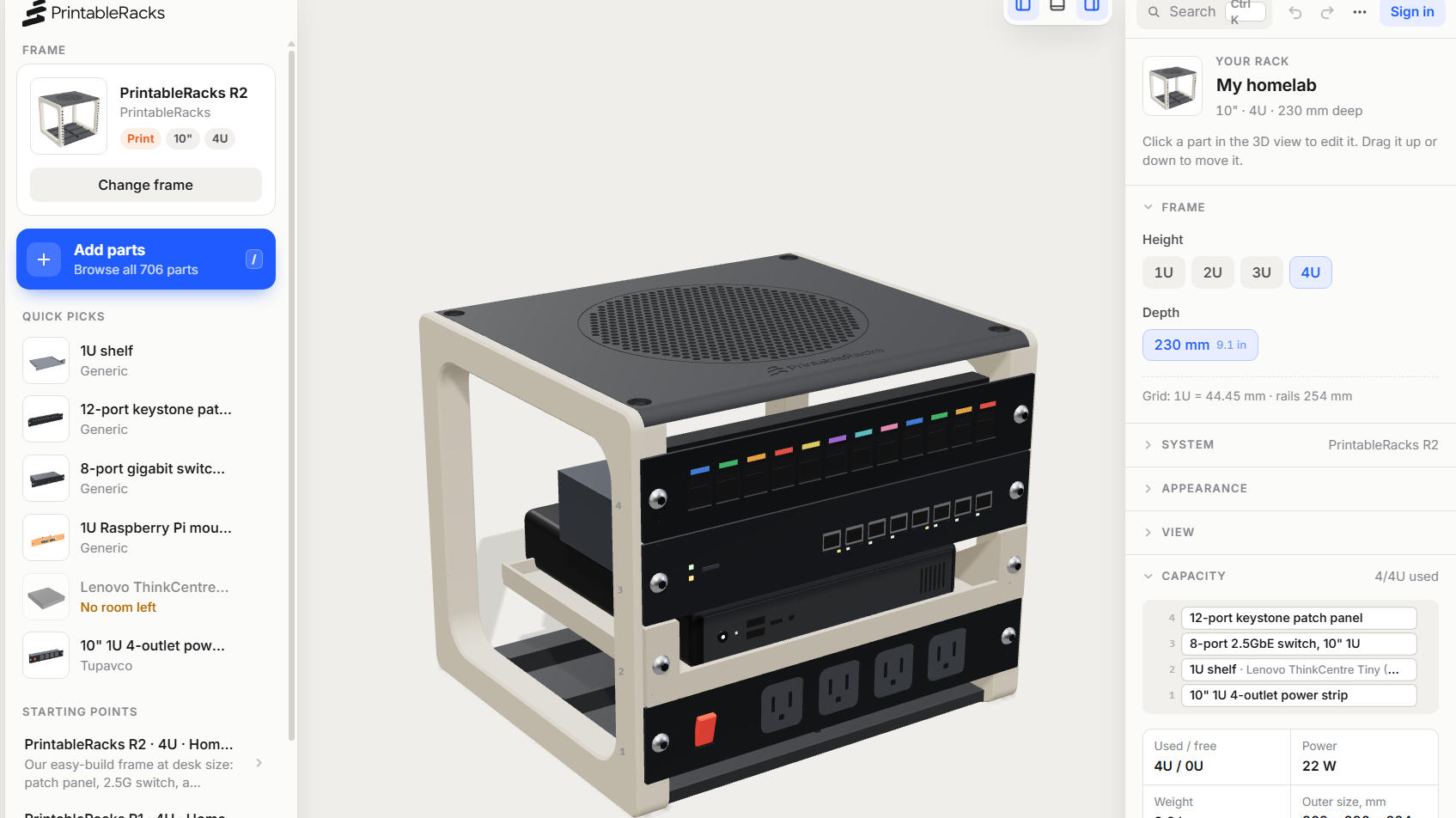
Printable Racks aims to democratize homelab organization by providing an accessible, user-friendly platform. Users can select from a variety of pre-designed frames or create their own, then populate them with components from an extensive catalog. This system is designed to simplify the process of planning and building a functional rack.
Hardware and Software Architecture for Custom Racks
The core of the Printable Racks system lies in its browser-based configurator and a comprehensive catalog of over 700 parts. Users begin by choosing a base frame, available in various printable or ready-made designs, typically for 10-inch rack formats. The tool then allows for the selection and placement of individual components, such as mini-PCs, switches, and storage devices.
A key feature is the integrated fit-checking mechanism. This functionality helps identify potential physical interferences between chosen components before printing, saving time and material. For users with unique hardware not present in the catalog, the system supports the import of custom part models, further enhancing its flexibility. This mirrors the adaptability seen in other modular hardware systems, like those enabling custom IoT solutions with devices such as the ESP32-S31 Development Kit.
Engineering Trade-offs and Design Limitations
While the Printable Racks tool excels at basic physical layout and component fit, it acknowledges certain limitations. The system primarily focuses on the spatial arrangement of hardware and does not inherently account for crucial factors like cable management or optimal airflow. Users must exercise their own judgment and planning to ensure adequate space for cabling and ventilation, which are critical for the long-term health and performance of homelab equipment.
The structural integrity and load-bearing capacity of 3D printed racks are also considerations. While designs like HomeRacker, which has been successfully implemented for mini-PCs and Raspberry Pis, demonstrate feasibility, users must ensure their chosen materials and print settings are robust enough for the intended weight. This is a common challenge in additive manufacturing for functional hardware, as highlighted in advancements for metal AM simulation.

Field Readiness and Verdict on Printable Homelab Racks
The Printable Racks solution represents a significant step forward for homelab enthusiasts seeking organized and personalized infrastructure. Its browser-based interface and extensive part library make it an approachable tool for designing custom rack solutions, even for those new to 3D printing or hardware configuration.
Despite its focus on physical fit, the ability to import custom parts and the inherent flexibility of 3D printing allow for highly tailored solutions. For users prioritizing a tidy and efficient homelab environment, these printable racks offer a cost-effective and customizable alternative to traditional, often expensive, rack hardware.
Source: Hackaday Engineering