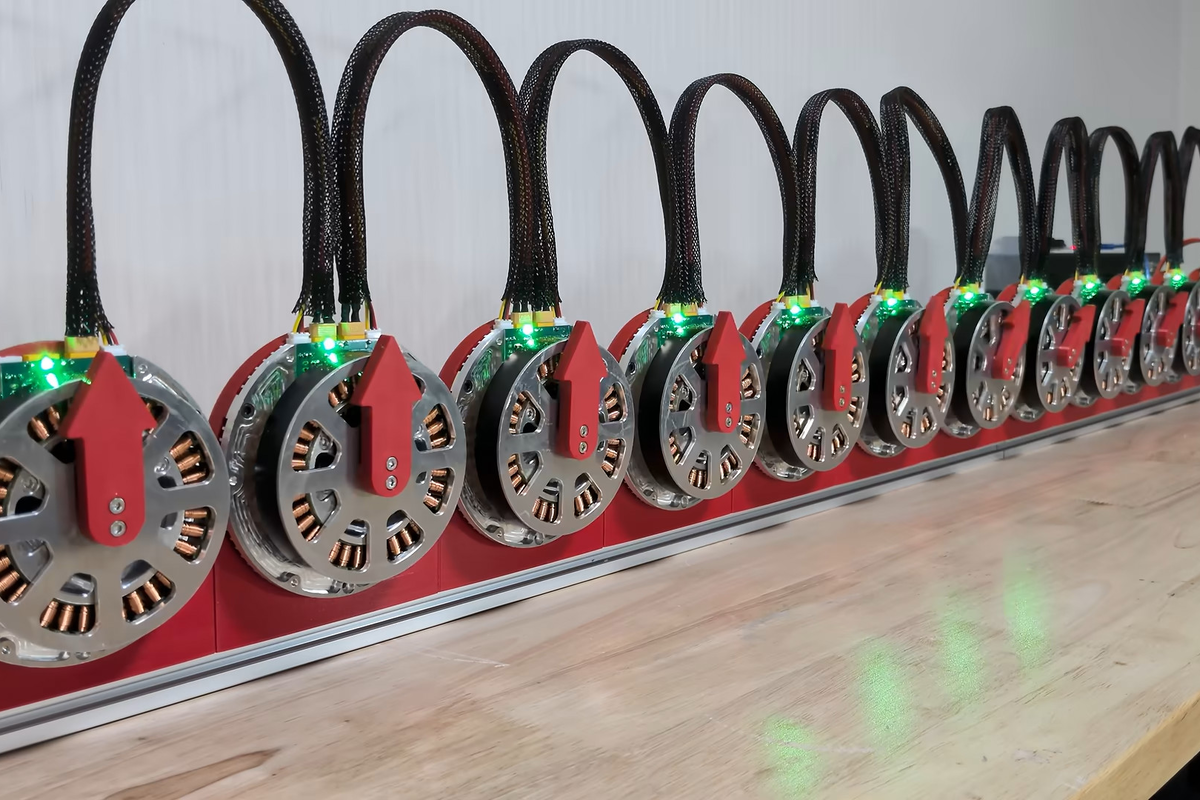
Breakthrough in Open-Source Robotic Locomotion: A Dozen DIY Robot Actuators
The quest for truly custom robotic components has reached a new milestone with a project showcasing a dozen completely DIY robot actuators. This endeavor, detailed on Hackaday, not only covers the mechanical construction of the actuators but also includes the development of their drivers and even the field-oriented control (FOC) firmware. This represents a significant step for experimentalist robotics, offering a pathway to drastically reduce costs for complex robotic systems.
Table of Contents
The core innovation lies in the accessibility and replicability of the design. While some high-precision components were sourced externally, the vast majority of the system, including the actuators and control electronics, were fabricated by the creator. This approach significantly lowers the barrier to entry for advanced robotics projects, empowering hobbyists and researchers alike.
Hardware Architecture and Assembly Advantages
A key design principle behind these DIY robot actuators was ease of assembly and integration, rather than extreme miniaturization. This philosophy led to a unique architecture where the 3D-printed gearbox and the motor controller are situated externally to the stator. This placement ensures efficient cooling for both components and simplifies the overall wiring process.
The wiring strategy further exemplifies the project’s focus on practicality and future scalability. A neat CAN-bus implementation, combined with XT-60 connectors for power and signal distribution, allows for straightforward daisy-chaining. This thoughtful approach to connectivity streamlines the assembly of multi-actuator systems, such as the intended quadruped robot, making subsequent development phases more manageable.
Software and Control System Integration
Beyond the hardware, the project delves into the critical aspect of motor control. The development of custom field-oriented control (FOC) firmware is a testament to the project’s comprehensive nature. FOC is essential for achieving smooth, efficient, and precise control over brushless DC motors, which are commonly used in robotic applications requiring dynamic movement.
The integration of custom firmware with the DIY robot actuators allows for fine-tuned performance characteristics. This level of control is crucial for applications demanding agility and responsiveness, mirroring advancements seen in other specialized hardware, such as the custom firmware unlocking advanced features in devices like the CMU200.
Engineering Trade-offs and Cost-Effectiveness
The decision to pursue a completely DIY approach for a dozen robot actuators is primarily driven by economics. When building a robot with numerous moving parts, the cost per unit is multiplied significantly. By fabricating these components in-house, the creator bypasses the high markups associated with commercial actuators, making ambitious projects financially feasible.

This strategy echoes the efforts of pioneers like Ben Katz and the MIT Cheetah team, who have explored custom actuator designs. However, this project adopts a more experimentalist-friendly stance, prioritizing accessibility and open sharing of designs and firmware. This democratizes advanced robotic capabilities, moving them beyond the confines of well-funded research labs.
Field Readiness and Verdict
While the project demonstrates impressive engineering and a clear path to cost reduction, its readiness for demanding industrial or commercial applications would require further rigorous testing and refinement. The focus on DIY and experimentalism means that long-term durability, environmental resistance, and mass-production scalability are areas for future exploration.
Nevertheless, the achievement of creating a dozen functional DIY robot actuators, complete with drivers and FOC firmware, is a remarkable feat. It provides an invaluable resource for roboticists looking to build custom platforms without prohibitive costs. The open-source nature of the design encourages further innovation and adaptation, solidifying its place as a significant contribution to the DIY robotics community.
Source: Hackaday Engineering