Metal AM Defect Detection Unlocks Critical Cost Savings
DN Solutions and Addiguru have showcased a pivotal advancement in metal additive manufacturing (AM) with their joint demonstration at Formnext 2026. This collaboration introduces an automated in-situ monitoring software that meticulously analyzes build data from DN Solutions’ DLX metal AM systems. The primary objective is to identify potential defects early in the AM process, thereby significantly reducing the substantial time and cost associated with downstream manufacturing and inspection stages.
Table of Contents
The system leverages powder bed images captured during a DLX build, enabling the software to automatically analyze each layer. It identifies potential defects and tracks their progression throughout the entire build process. This proactive approach promises to revolutionize quality control in metal AM, a sector where post-processing costs can be prohibitively high.
Automated In-Situ Analysis for Early Defect Identification
Traditionally, manual review of thousands of layer images is an arduous and time-consuming task for engineers. Addiguru’s software automates this process, analyzing each layer of a DLX build with remarkable speed and accuracy. By identifying potential defects and tracking them in real-time, the platform highlights areas of concern and can alert users to potentially critical issues as they arise.
The timing of defect detection is crucial. Printing a metal component is often just the first step in a complex manufacturing chain. According to DN Solutions and Addiguru, up to 50 percent of a component’s total cost can be incurred after the initial printing phase. A defect introduced during the build, if only discovered after heat treatment, CNC machining, or final inspection, can lead to exponentially escalating expenses.
“A defect found during the build costs a reprint. Found after 5-axis finishing and CT, it costs the reprint plus every machine hour and inspection that went into the part,” stated Dr. Vino Suntharakumaran, Vice President Additive Manufacturing at DN Solutions. Addiguru CEO Shuchi ‘SK’ Khurana echoed this sentiment, emphasizing the inefficiency of waiting for expensive post-machining inspections to uncover issues detectable during the build itself.
Bridging Machining Expertise with Additive Manufacturing Innovation
This collaboration is deeply rooted in DN Solutions’ extensive expertise in CNC machining. With decades of experience in helping customers produce finished parts using machine tools, the company’s DLX series represents a strategic entry into metal additive manufacturing. By offering both printing and machining capabilities under a single supplier, DN Solutions is uniquely positioned to integrate these processes more seamlessly than when they are managed by separate vendors.
Khurana highlighted this end-to-end perspective as a key driver for the partnership. He noted that DN Solutions possesses a comprehensive understanding of the entire manufacturing journey, from an additively manufactured preform to a fully finished component. Integrating Addiguru’s advanced monitoring into this workflow empowers manufacturers to identify problems at the earliest possible stage, thereby avoiding unnecessary costs and rework.
Advanced Software Features and Future Development
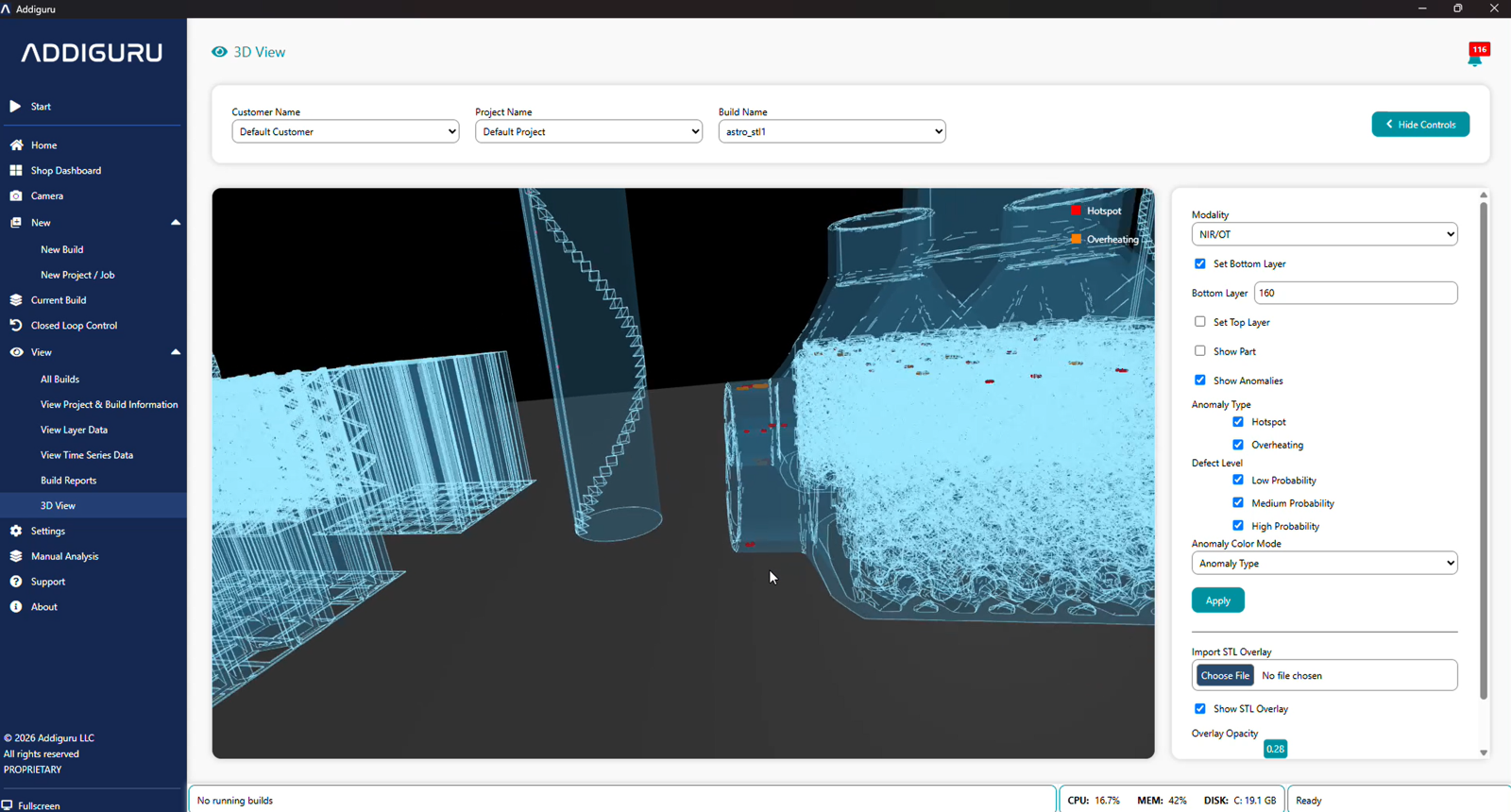
Addiguru utilized Formnext 2026 not only for the joint demonstration but also to launch significant upgrades to its machine-agnostic monitoring platform. A standout feature is the enhanced 3D View, which allows users to import the build’s CAD geometry and visualize detected process anomalies directly on the corresponding 3D model. This eliminates the reliance on isolated layer images or 2D data, providing engineers with precise location information for anomalies within the part.
The platform now also incorporates multimodal data registration, consolidating data from optical, near-infrared (NIR), and long-wave infrared (LWIR) sensors into a unified interface. This enables manufacturers to correlate thermal changes detected by thermal monitoring with optical process data from the same build without manual cross-referencing of disparate datasets. This integrated approach is reminiscent of how advanced solvers, like those benefiting from NVIDIA cuDSS 1.0’s significant speedups, process complex data streams for engineering applications.

On the thermal analysis front, customers can now monitor inter-layer temperatures using a standalone LWIR camera. Addiguru has also refined its hotspot detection algorithms, improved NIR image generation, and expanded its inter-layer temperature analysis capabilities to encompass a wider range of materials and operating conditions, including multi-laser machines. These advancements are crucial for ensuring the integrity of complex metal AM parts.
Moving Quality Assurance Upstream
The collaboration between DN Solutions and Addiguru represents a significant industry trend towards integrating quality checks directly onto the build plate. This move upstream in the manufacturing process aims to reduce the dependency on costly post-build inspection methods such as computed tomography (CT) scanning. While in-situ monitoring is not intended to replace these established quality assurance processes, it provides invaluable early insights, guiding manufacturers on where further, more intensive investigations are warranted.
This initiative aligns with broader industry efforts to streamline metal AM workflows. Companies like Nikon SLM Solutions are embedding monitoring capabilities directly into their systems through software like SLMX, which integrates thermal control, simulation, and layer-by-layer monitoring. Similarly, Phase3D’s work on real-time inspection for metal AM, even when paired with third-party hardware, underscores the growing emphasis on proactive defect detection.
The core argument remains compelling: catching a defect on the build plate is considerably more cost-effective than discovering it after extensive post-processing. DN Solutions and Addiguru’s joint solution offers a tangible path toward achieving this goal, promising enhanced efficiency and reduced costs for the metal additive manufacturing sector.
Source: 3D Printing Industry