
Freight Volatility Moves to the P&L: Is Your 2027 Budget Ready?
The landscape of freight management has fundamentally shifted, with operational volatility now directly impacting financial statements. Insights from Supply Chain Day at F3 2026 reveal that the traditional challenges of the loading dock have transformed into budget variance reports. This evolution demands a proactive approach to financial planning, especially as 2027 bids are being finalized.
Table of Contents
This report delves into the critical factors influencing freight costs and carrier capacity, drawing from data presented at F3 2026 and analysis from SONAR. Understanding these dynamics is crucial for CFOs and logistics leaders tasked with building a resilient freight budget for the upcoming year.
The Shifting Freight Market: Data and Expert Insights
Supply chain volatility is no longer a mere operational concern; it is a significant financial one. Craig Decker, Head of Transportation & Logistics Services and Infrastructure at Brown Gibbons Lang & Company (BGL), and Zach Strickland, Director of Freight Market Intelligence at SONAR, highlighted this transition during their F3 2026 fireside chat. Their discussion underscored how current market conditions necessitate a strategic re-evaluation of budgeting practices.
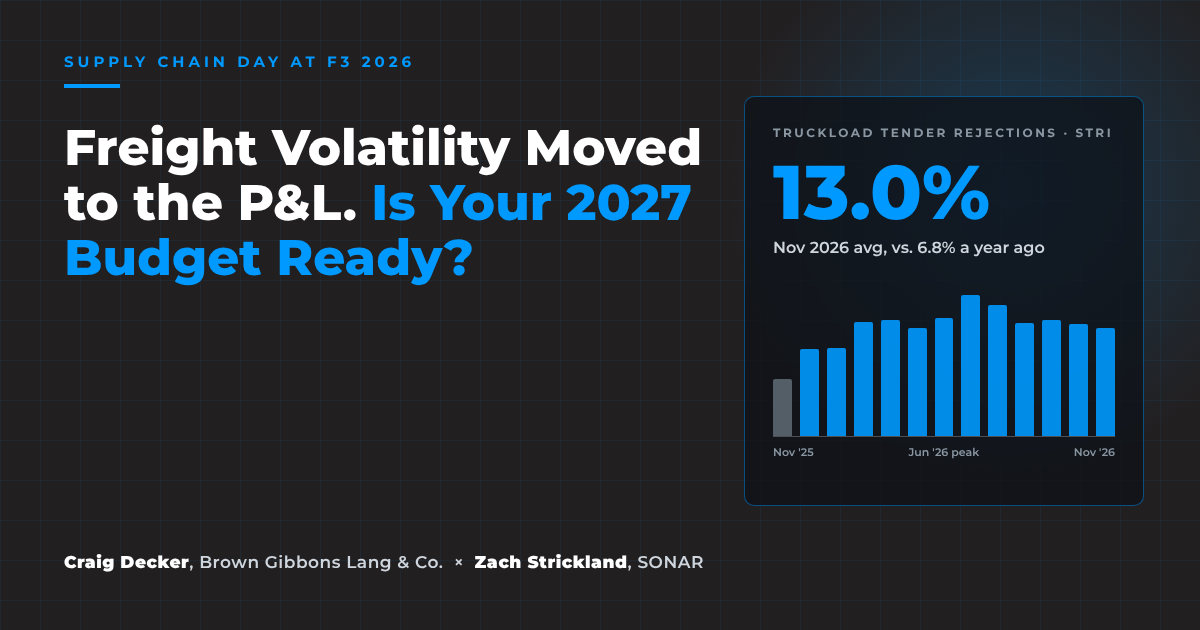
SONAR data from November 2026 indicates a dramatic increase in tender rejections, doubling from the previous year to an average of 13.0%. This sustained high rate means approximately one in eight contracted loads is being rerouted, incurring unforeseen costs. Tender volume also saw an 11% increase, signaling continued demand pressure.
Decker emphasized the severity of the situation, stating, “I haven’t seen our transport costs rise this much on a material basis in the 30 years I’ve been doing this.” This suggests that shippers should anticipate a prolonged period of high-cost logistics, rather than a temporary spike.
Dealmaker’s Perspective: Capital and Consolidation in Freight
The current market tightening is driven by capacity reduction rather than a surge in demand, influencing merger and acquisition (M&A) activities. Buyers are strategically investing, with median transportation and logistics deal multiples rising to 10.2x EBITDA in early 2026. Interest is particularly focused on businesses with high-margin, recurring shipper revenue, such as dedicated contract carriage and resilient sectors like healthcare and cold chain.
In the Less-Than-Truckload (LTL) sector, consolidation is favoring larger carriers acquiring smaller networks. Rising operating costs are accelerating this trend, pushing more small carriers toward divestment. This consolidation reshapes the competitive landscape and impacts carrier availability for shippers.
Furthermore, increased broker risk, following the Supreme Court’s ruling in Montgomery v. Caribe Transport II, makes documented carrier vetting a critical balance-sheet consideration. Shippers must ensure their partners demonstrate rigorous diligence to mitigate liability.
The consolidation extends to freight technology providers as well. Financial pressures and strategic interests are driving M&A, altering the ownership of essential data and tools that shippers depend on. This means the carriers and brokers in a shipper’s current routing guide may undergo significant changes before 2027 contracts are finalized.
Strategic Questions for the 2027 Freight Budget
To prepare a robust freight budget for 2027, finance leaders must move beyond paper contract rates and consider the practical realities of the routing guide. Six key questions should guide this process:
- What is the true cost of a failed tender? Model your budget assuming 13% of loads will require backup carriers or spot market engagement.
- What is your acceptable level of spot market exposure? Define a target share before initiating RFPs and price contracts accordingly.
- Are your chosen carriers financially resilient? Assess fleet trends, ownership structures, and safety records, not solely rate proposals.
- Can your brokers demonstrate thorough carrier vetting? Verify their documented diligence processes, especially post-Montgomery ruling.
- Where can modes or contract types be optimized? Evaluate opportunities to shift eligible lanes to intermodal or from spot to contract where data supports it.
- When were your Master Service Agreements (MSAs) and payment terms last reviewed? Old agreements, default payment cycles, and unchecked surcharges can lead to significant financial leakage.
Addressing these questions proactively will help build a freight budget that reflects actual market conditions and operational realities. This strategic approach is vital for navigating the complexities of modern logistics.
Leveraging Payables and Line Items for Savings
Beyond core rates, significant savings can be unlocked by scrutinizing payables and individual line items. Decker advises shippers to review legacy MSAs, as renegotiating terms can yield substantial savings. One example cited a $3 million saving through such a review, optimizing the use of both shipper and partner balance sheets.

Utilizing payment cycles effectively, such as taking advantage of short-pay discounts, can generate real value. With current high interest rates, early-payment discounts can offer a better return than idle cash. Fast payments are also highly valued by carriers in the current environment.
A thorough audit of every line item is essential. Understanding exactly what is being paid for, particularly fuel surcharges, is critical. Renegotiating fuel surcharges to align with regional PADD diesel prices, for instance, ensures they more accurately reflect actual fuel costs. This granular attention to detail is key to optimizing the freight budget.
The overarching message is clear: stability in freight management stems from enhanced data utilization and extended planning horizons. Market intelligence platforms like SONAR empower teams to anticipate and act on market shifts before they manifest as financial problems. This proactive stance is essential for building a resilient freight budget and navigating the complexities of the 2027 fiscal year.
The operational shocks of 2026 have coalesced into a predictable financial pattern: increased rejections, rising costs, and ongoing carrier consolidation. Shippers who thrive in 2027 will be those whose finance and transportation departments align their strategies based on shared data, well before bid cycles close. For those seeking to enhance their financial preparedness, exploring solutions that provide deep market insights is paramount.
To learn more about how market intelligence can fortify your 2027 budget and network, request a demo of SONAR.
Source: FreightWaves Supply Chain Tech
