

The 10-Second Story: While AI tools are increasingly capable of writing code, human engineers are indispensable for making critical system design decisions, ensuring relevance, and verifying the final product.
The Evolving Role of the Engineer in AI-Assisted Development
The narrative surrounding AI’s impact on software development often focuses on code production. However, the transformation is more nuanced.
AI agents can significantly assist with implementation, analysis, design, and testing, but the core responsibility for defining what a system should achieve and the criteria for accepting its success remains with human engineers.
This doesn’t eliminate engineering responsibilities; it reshapes them. The focus shifts from manual code churning to strategic oversight, ensuring that AI-generated code aligns with durable decisions, relevant context, and verifiable progress.
The practical challenge lies in integrating these tools effectively, maintaining visibility into decisions, and ensuring feedback remains meaningful.
Establishing Durable Decisions and Context
Conversations with AI are excellent for exploring possibilities, but they are not ideal for preserving critical architectural decisions. AI models have bounded context windows, and summaries can lose the crucial conditions that made a decision sound.
To counter this, engineers should establish a persistent record of key decisions. A document like PROJECT_GUIDE.md can house the product’s purpose, scope (including exclusions), system boundaries, architectural rationale, quality expectations, and links to more detailed explanations.
For each development increment, providing relevant files and a clear summary of the intended change, constraints, and acceptance criteria allows for early detection of misunderstandings. This selective retrieval and deliberate context management are key to effective AI collaboration.

Defining Verifiable Behavior and Acceptance Criteria
Consider a hypothetical mobile search screen feature: “As a user, I want to search saved items so that I can find an item without scrolling through the entire collection.”
For the initial increment, the scope is local search over existing items, excluding remote search and persistence changes. Before implementation, explicit acceptance cases are vital:
- A matching query displays the expected items.
- A query with no matches displays an empty result state.
- Clearing the query restores the complete collection.
- If filtering is asynchronous, older results do not overwrite newer query results.
These cases highlight technical questions, such as whether asynchronous work is truly necessary, which should be resolved based on data size and responsiveness requirements.
The engineer’s choice of architectural patterns, like unidirectional data flow and explicit UI states, should be documented in feature-level notes, explaining the behavior and new decisions without replicating the entire architecture.
Post-increment, inspecting the code diff, running checks, and exercising the application are essential. Passing tests does not automatically validate architectural adherence or correct behavior if the tests themselves are flawed.
Ensuring AI Output Answers to Verification
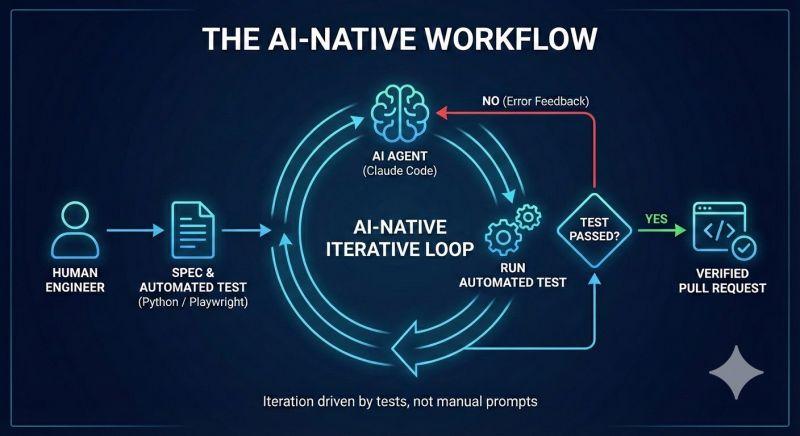
AI output is probabilistic, meaning acceptance must be based on inspectable and reproducible evidence. Local verification commands—running formatters, static analysis, compilation, and focused tests—provide different layers of assurance.
However, these checks are only as good as their inputs. Controlled conditions, including tool versions, fixtures, and execution environments, are critical.
Tests involving timing, networks, or external services can be flaky, and even seemingly deterministic checks can verify the wrong aspect of behavior. A search test, for example, might pass if any result appears, without verifying the correctness of that specific result.
Engineers must review assertions against acceptance cases and use deliberately chosen examples, including failure scenarios.
Running the application provides real-world feedback, but performance metrics require defined measurements (device, dataset, scenario, threshold) to be meaningful. While local hooks can catch mistakes early, enforced policies often require server-side checks and repository protections.

Documentation: A Practical Measure of Value
The creation of extensive documentation alongside small code changes can become a burden, requiring review, reconciliation, and maintenance. The value of documentation lies in its ability to support specific decisions, implementations, or verification steps, and in the clarity of who will maintain it.
While some documentation, like compatibility constraints, may require significant detail, repetitive prose that doesn’t inform decisions or evaluations should be removed. Agile principles emphasize working software and technical excellence, and documentation should serve these aims proportionally.
For safety-critical systems, regulated work, or complex coordination, stronger specifications are valuable, but they serve as entry points to necessary detail, not replacements for it. The focus should be on composable, adaptable guidance that supports the engineering workflow.
The Engineer’s Final Decision: Acceptance and Iteration
Even small increments can contain flawed assumptions, making early and bounded discovery crucial. The recommended loop involves defining the next behavior, providing necessary context, checking the AI’s interpretation, inspecting the changes, gathering evidence, and making an explicit acceptance decision.
Durable guidance should be updated when decisions evolve. If the review process becomes unmanageable, reducing the increment size or improving verification checks is more effective than simply asking the AI to produce more.
This approach relies on the engineer’s understanding, the quality of evidence, and the effort of maintaining guidance. Ultimately, the engineer must be able to explain what was requested, what changed, and why the evidence supports acceptance—this is the standard for AI-assisted development.

Field Readiness: High. AI tools are rapidly advancing in code generation, but the need for human engineering judgment in system design, decision-making, and verification remains paramount.
The integration requires a pragmatic approach to documentation, context management, and robust verification processes.
Source: Originally reported by Techswire Aggregate (rss.app).