The 10-Second Story: Microsoft has unveiled the Type Server Protocol (TSP), a specialized communication system designed to give development tools unprecedented insight into Python code’s structure and behavior.
How It Works (The Big Picture)
Imagine you have a super-smart assistant who’s an expert in Python.
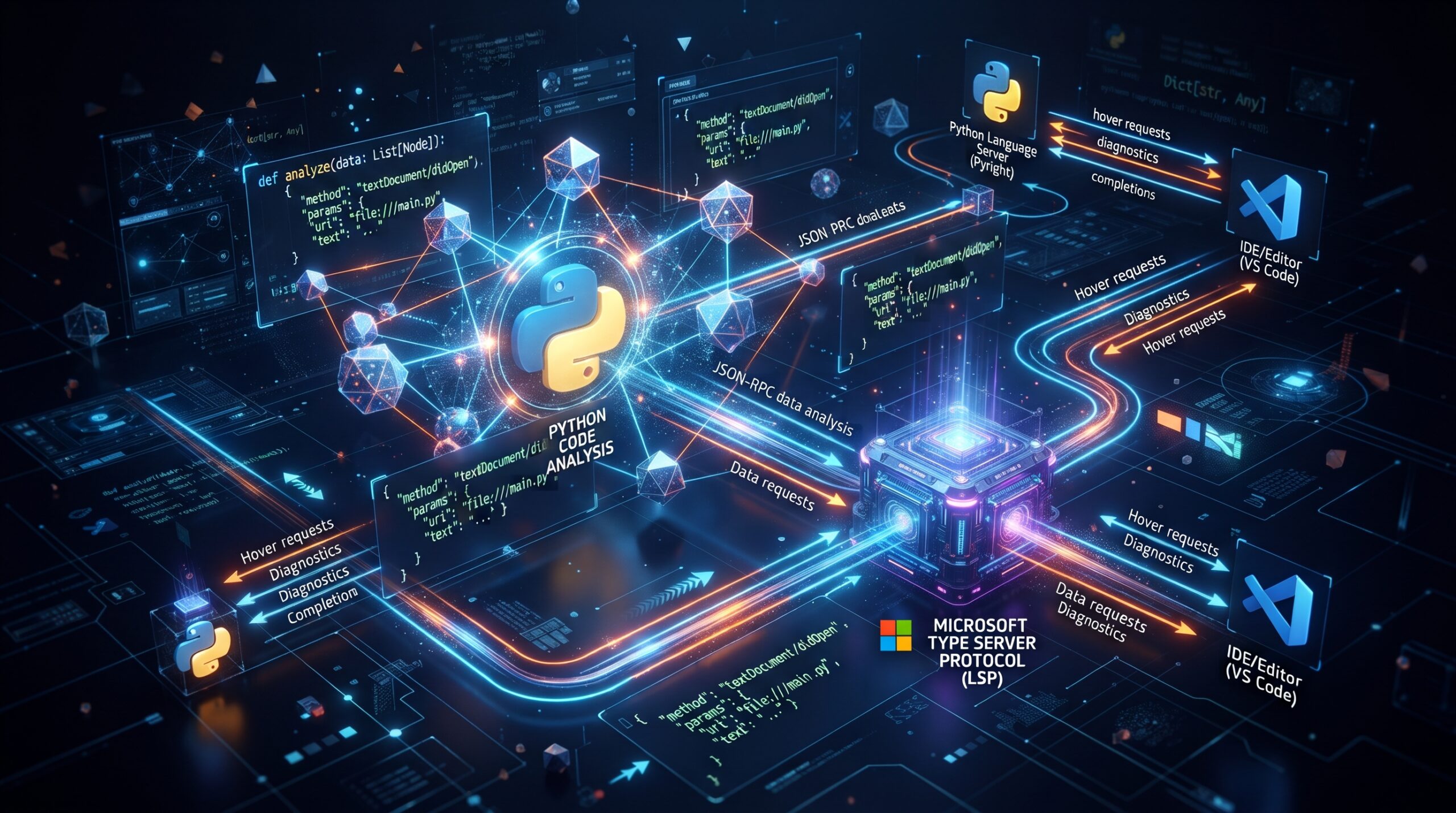
This assistant (the ‘type server’) reads all your Python code for a project and keeps track of every variable, function, and class – not just what they’re called, but what *kind* of data they hold and what they’re supposed to do.
The Type Server Protocol (TSP) is like the secret language you use to ask this assistant questions. Instead of just saying ‘what’s this variable?’, you can ask very specific things like ‘what type of data is *supposed* to be here?’ or ‘what are all the ways this function can be called?’.
This language is built on sending messages back and forth using a structured format called JSON-RPC, similar to how many web services talk to each other.
This allows tools like code editors to provide incredibly accurate suggestions, catch errors before you even run your code, and help you navigate large projects with ease.
The Engineering Under the Hood
- System Mechanics: TSP is a JSON-RPC protocol, meaning it uses structured messages (like digital postcards) to communicate. A ‘type server’ acts as the brain, holding all the analysis data for your Python project. Your development tool (the ‘client’) talks to this server to get information. The protocol uses familiar concepts from the Language Server Protocol (LSP), like defining specific locations in code (Position and Range), and represents file paths (URIs) as text strings. All communication is prefixed with ‘typeServer/’ to keep things organized.
- Version Control: TSP uses semantic versioning (like 1.2.3) to ensure clients and servers can understand each other. During the early stages (0.x versions), minor updates might break compatibility, but patch updates (like 0.1.1 to 0.1.2) are safe.
- Connection Management: A client typically starts the type server and communicates over a main connection. This connection handles initial setup, project details, and any commands that change the server’s understanding of the code. For performance, TSP also supports optional ‘extra’ connections. These are read-only channels used for high-volume requests, like asking for type information on many different parts of the code simultaneously, without slowing down the main communication line. This is like having a dedicated line for quick lookups while the main phone line handles important discussions.
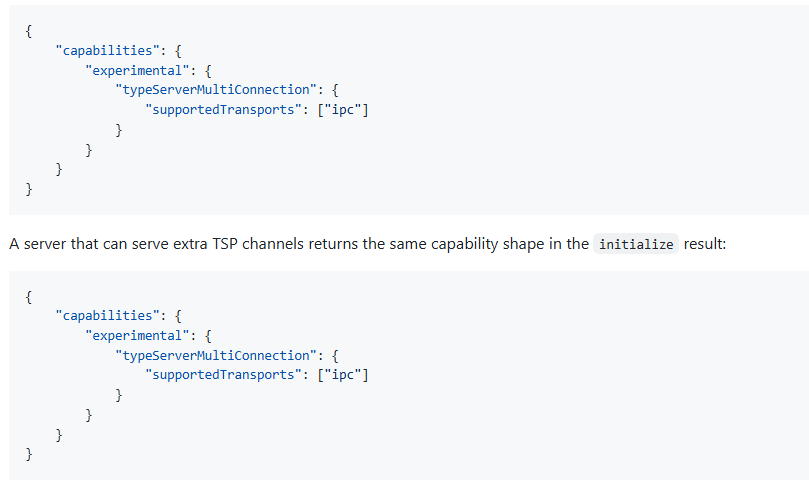
- Multi-Connection Mode: This optional feature allows a client to open additional, separate communication lines to the same type server. These extra lines are strictly for read-only requests. The main connection remains in charge of managing the project’s state. This mode is beneficial when a tool needs to perform many read-only operations concurrently, such as performing extensive type checks or background analysis, without blocking the primary interaction channel. Both the client and server must agree to use this mode during the initial setup (the ‘initialize’ handshake).
- Transport Layers: Communication can happen over standard input/output streams (stdio) or more direct methods like Node IPC (Inter-Process Communication). When using stdio, the standard output must be reserved solely for TSP messages. For extra connections, ‘ipc’ is a common transport mechanism, allowing the server and client to establish dedicated communication channels.
- Snapshotting: The type server keeps track of its analysis state using ‘snapshots’. Each snapshot is a point-in-time view of the code’s understanding. When the code changes (files are opened, modified, or dependencies update), the server creates a new snapshot. All information returned by the server is tied to a specific snapshot, ensuring accuracy.
- Type Representation: TSP defines how different Python types (like integers, strings, custom classes, or complex unions) are represented in messages. These are JSON-serializable objects, each with a unique ‘kind’ identifier and a set of flags, making it clear to the client what kind of data it’s receiving.
- Error Handling: Standard JSON-RPC error responses are used. These errors provide enough detail for debugging without revealing sensitive internal implementation details.
Vulnerabilities & System Hardening
The primary security consideration for TSP lies in the integrity of the communication channel and the data exchanged. Since TSP deals with deep code analysis, a compromised type server or client could potentially lead to the exposure of sensitive code structure or the injection of malformed data that could crash analysis tools. Robust validation of incoming messages on both client and server sides, along with secure transport mechanisms (especially when using IPC), are crucial. Ensuring that extra connections strictly adhere to read-only operations prevents accidental or malicious state modification. The protocol’s versioning also plays a role; clients should only use features supported by the negotiated TSP version to avoid unexpected behavior.
Techswire Bottom Line
Field Readiness: TSP is a foundational technology enabling the next generation of intelligent Python development tools. Its detailed specification allows for precise and efficient code analysis, promising significant improvements in developer productivity and code quality. While still evolving, its design principles are robust, focusing on clear communication and performance optimization.