The Evolving Landscape of Freight Fraud
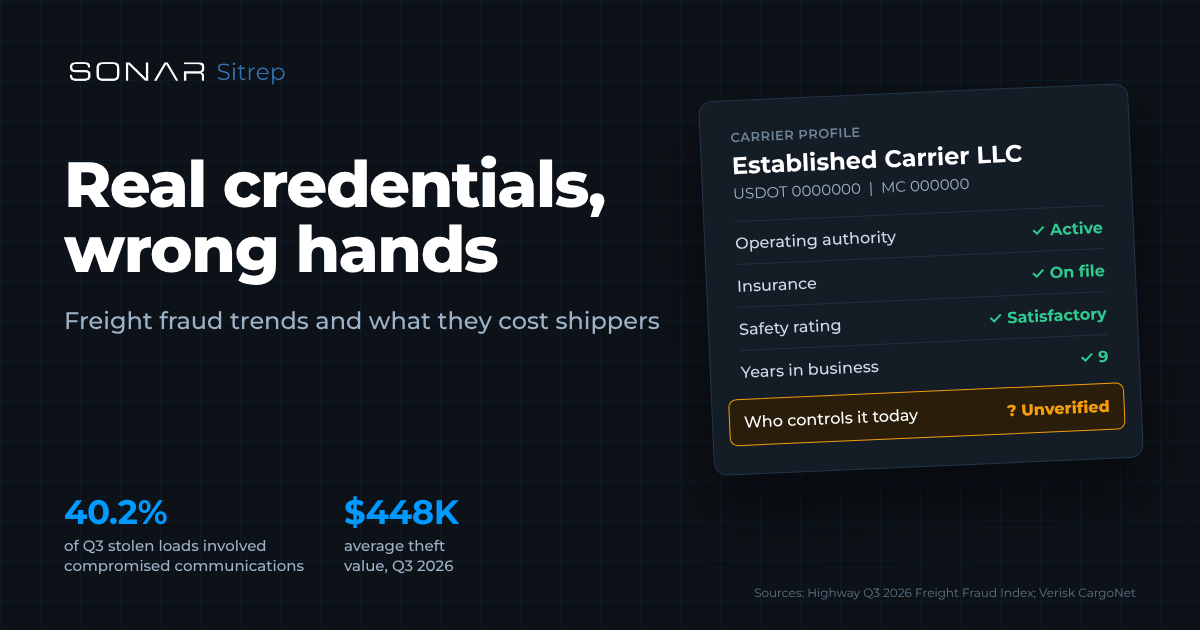
Freight fraud is no longer a game of fake carriers. In the third quarter of 2026, a staggering 80% of stolen loads reported to Highway involved the misuse of legitimate carrier credentials. This alarming trend highlights a shift towards sophisticated schemes where hijacked inboxes, purchased motor carrier authorities, and even rogue carriers with seemingly clean records are exploited.
Table of Contents
While reported theft counts saw a decline in Q3 at both Highway and Verisk CargoNet, the financial impact of each incident is escalating. The operational burden is increasingly falling upon shippers, placing them directly on the front lines of cargo theft. This evolving threat demands a robust response from all stakeholders in the supply chain.
Market Pressures Fueling Fraudulent Activities
Current market conditions are creating a fertile ground for freight fraud. National truckload tender rejections (STRI.USA) stand at 12.78%, a significant increase from the 6.3% recorded a year ago. Similarly, reefer rejections (STRIR.USA) are nearing 22%, indicating extremely tight capacity.
Historically, the fourth quarter tends to exacerbate these capacity constraints. This heightened urgency and demand are precisely the conditions that fraud schemes are designed to exploit. The pressure to move goods quickly leaves less room for thorough verification processes, making legitimate credentials vulnerable.
Key Findings in Freight Theft Trends
Highway reported 184 stolen loads in Q3, a 28.1% decrease quarter-over-quarter. Compromised communications were responsible for 40.2% of these incidents, while direct theft by carriers accounted for 36.4%. This suggests a growing reliance on social engineering and communication interception tactics.
Verisk CargoNet documented fewer incidents in Q3, with 547 cases, a 33% year-over-year decrease. However, the financial losses surged by 12% year-over-year to $230.1 million. The average value of each theft climbed by approximately 72%, reaching $448,456, underscoring the increasing financial stakes.
Interestingly, theft trends did not directly mirror capacity fluctuations. While truckload rejections remained relatively flat from Q2 to Q3, Highway observed a 28% drop in stolen loads. This suggests that enhanced verification controls, potentially driven by increased awareness, are making a difference in mitigating certain types of fraud.
Geographic Hotspots and Shrinking Capacity
The leading states for theft—California, New Jersey, and Texas—are currently experiencing rejection rates below the national average. This indicates that these hot spots are more influenced by their status as major freight hubs and resale demand rather than solely by capacity tightness.
The carrier base is also contracting, with preliminary data showing a 35% year-over-year decrease in new for-hire fleets and a 6.4% reduction in for-hire tractors. This shrinking of verified capacity, particularly as holiday demand intensifies, further complicates the security landscape and amplifies the risk of freight fraud.
Reefer freight faces a dual threat: it is subject to some of the tightest market capacity and is a primary target for thieves due to the high demand for food and beverage products. This makes temperature-controlled logistics particularly vulnerable.

Legal Precedents and Future Implications
The affirmed C.H. Robinson verdict, now exceeding $700 million with interest, has significantly raised broker risk costs. These increased costs are likely to be passed on to shippers through higher rates and more stringent routing guides.
This evolving environment necessitates enhanced due diligence and verification protocols for all parties involved in freight transportation. The shift towards utilizing real credentials in fraudulent activities underscores the need for advanced cybersecurity measures within the logistics sector. Technologies similar to those used in advanced AI verification, such as those explored in post-quantum hardware, may eventually offer more robust solutions for securing digital identities and transaction integrity in the future.
Verdict: Heightened Vigilance Required
The current climate of tight capacity and sophisticated fraud schemes demands heightened vigilance from shippers. The increasing value of stolen loads and the operational burden shifting downwards necessitate a proactive approach to security.
Companies must invest in comprehensive verification processes, stay informed about emerging fraud tactics, and collaborate with trusted partners. The battle against freight fraud requires continuous adaptation and a commitment to securing the entire supply chain, from initial tender to final delivery.
Source: FreightWaves Supply Chain Tech