
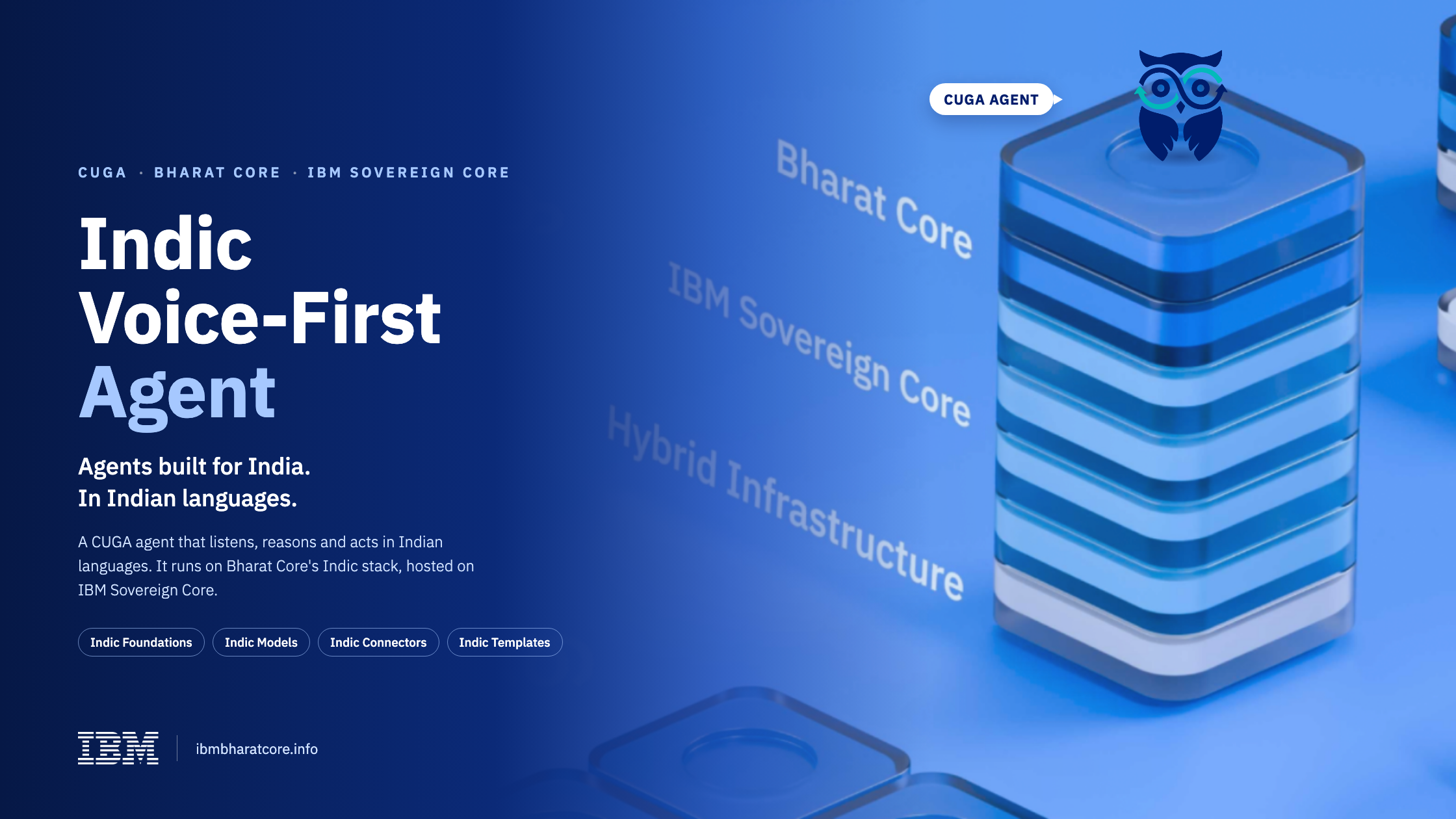
Indic Voice Agent with CUGA: Bridging the Language Divide in AI
The vast majority of digitized knowledge resides in English, yet billions worldwide communicate and think in regional languages like Hindi, Tamil, and Marathi. Recognizing this critical gap, IBM Research has developed a novel Indic Voice Agent, utilizing their open-source Configurable Generalist Agent (CUGA) harness. This innovative solution aims to democratize access to information by enabling users to interact with AI in their native tongues, moving beyond the limitations of text-based, English-centric interfaces.
Table of Contents
This advancement is particularly significant for sectors like agriculture, where practical knowledge can dramatically improve livelihoods. Imagine a farmer asking, “How do I tell good seed from bad?” in their local dialect. The Indic Voice Agent, powered by CUGA, can provide accurate, contextually relevant answers sourced from English documentation, demonstrating a powerful application of cross-lingual information retrieval.
CUGA Harness: The Foundation for Versatile AI Agents
At its core, CUGA (ConfigUrable Generalist Agent) is designed as a flexible, text-in, text-out AI framework. It simplifies agent development by managing the complex underlying loops of model integration, tool usage, state management, and guardrails. Developers can focus on creating specific tools and crafting effective prompts, rather than building the entire agent infrastructure from scratch.
In this application, CUGA acts as an embedded SDK within a lightweight web application. The agent’s functionality is primarily driven by its `agent.knowledge.search()` capability. This allows the system to query and retrieve information from a knowledge base, which is then processed and presented to the user.
The integration of voice is achieved through two thin layers surrounding CUGA’s text-based engine. This modular approach allows for easy swapping of speech providers. Options include cloud-based APIs from Sarvam AI, directly accessible from the user’s browser, or open-source models like SraVaani for speech-to-text and Svara for text-to-speech, which can be hosted on-premises for greater data sovereignty.
Engineering the Cross-Lingual Retrieval Challenge
The most significant engineering hurdle in developing the Indic Voice Agent was achieving effective cross-lingual retrieval. Standard embedding models, often trained exclusively on English data, struggle to represent the semantic meaning of non-English queries. When a Hindi or Tamil question was processed by an English-only embedding model, the resulting vectors lacked the necessary meaning, leading the agent to incorrectly state that the information was not available.
The solution involved integrating a multilingual embedding model, specifically `intfloat/multilingual-e5-large`. This model ensures that queries in different languages map to similar vector representations if they share the same meaning. This approach eliminates the need for maintaining multiple translated versions of the knowledge base, as a single English document can serve users across various linguistic backgrounds.
A crucial piece of advice stemming from this work is to validate cross-lingual search capabilities early in the development process. Before fine-tuning prompts or other agent behaviors, testing the agent with queries in target non-English languages is essential to confirm it can locate the correct information.
Guardrails and Future Potential
Beyond retrieval, the agent incorporates essential guardrails, such as an `OFF_TOPIC` handler. This feature allows the agent to politely redirect conversations that stray from the intended domain, like farming, without requiring an additional, time-consuming LLM call. This maintains the responsiveness of the voice interaction.
The potential applications for this technology extend far beyond agriculture. By swapping the knowledge base, the same architecture can power assistants for healthcare, legal advice, or government services. This flexibility, combined with the ability to choose between cloud and on-premises speech processing, allows for tailored deployments that meet specific needs regarding speed, cost, and data privacy. The development of this Indic Voice Agent aligns with IBM’s broader initiatives like IBM Bharat Core, which focuses on building secure, sovereign AI solutions for the Indian market.
This work represents a significant step towards making digital services truly accessible to everyone, regardless of their primary language. By building on open, auditable frameworks like CUGA, these voice-first, multilingual assistants can foster trust and empower communities previously underserved by technology.
Source: Hugging Face Technical Blog
URL: https://huggingface.co/blog/ibm-research/an-indic-voice-agent-with-cuga
