Fraunhofer IAPT Unlocks Metal AM Efficiency with Ultrasound Support Removal
German research institute Fraunhofer IAPT has unveiled a groundbreaking automated process leveraging ultrasound for the efficient removal of support structures from 3D printed metal parts. This innovative method promises to drastically cut down post-processing times, eliminate manual labor, and enhance the overall quality and repeatability of metal additive manufacturing (AM). The institute demonstrated this technology publicly for the first time at Formnext 2026, signaling a significant step forward in industrial AM adoption. Fraunhofer IAPT has also filed a patent application for this transformative process.
Table of Contents
The Challenge of Support Structures in Metal AM
Support structure removal remains a significant bottleneck in the metal additive manufacturing workflow. This labor-intensive step often requires manual intervention, leading to variability in part quality and potential health risks for workers due to exposure to fine metal powders. Delicate geometries and internal channels further complicate this process, demanding precision and time.
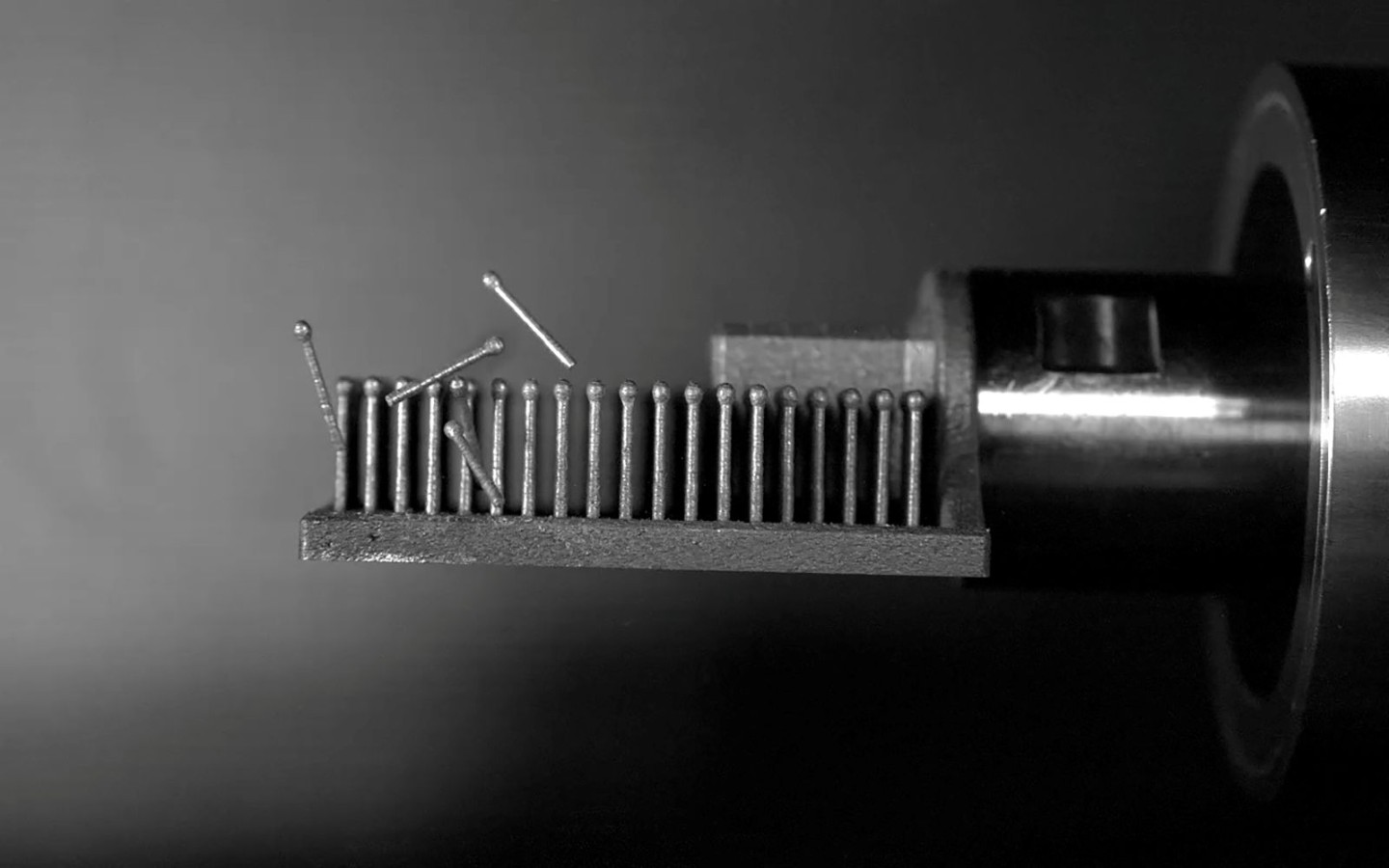
Fraunhofer IAPT’s novel approach directly addresses these challenges by replacing manual labor with high-frequency mechanical vibrations. The system applies ultrasonic frequencies to the printed component, inducing strong vibrations that are particularly concentrated in the support structures. By carefully tailoring vibration settings to specific components and designing supports optimized for ultrasonic failure, the institute achieves a resonant effect.
This resonance concentrates stress at the interface between the support and the part, causing the supports to break away cleanly and efficiently. The result is a significantly faster, more stable, and repeatable support removal process, ensuring consistent quality across multiple parts. This advancement is crucial for scaling up metal AM production, moving it closer to the efficiency seen in traditional manufacturing methods.
Automated Support Removal Architecture
The core of Fraunhofer IAPT’s system involves a robust coupling between the metal AM part and a specialized ultrasonic transducer. This transducer generates high-frequency mechanical waves that propagate through the component. The key innovation lies in the synergy between precisely controlled vibration parameters and specially designed support geometries.
These tailored supports are engineered to enter a state of resonance when subjected to the specific ultrasonic frequencies. This resonance amplifies the vibrational energy directly at the points of attachment, initiating a clean fracture and detachment of the support material. The process is designed to be low-cost, utilizing equipment that can be readily integrated into existing production lines, thereby enabling full automation.
This automation is vital for industries seeking to leverage the full potential of additive manufacturing. For instance, advancements in AI chip efficiency, such as those enabling 5x improvements in HPC, highlight the industry’s drive towards greater automation and performance. Similarly, Fraunhofer IAPT’s ultrasound method automates a previously manual step, aligning with this broader trend of technological acceleration.
Engineering Trade-offs and Future Limitations
While the ultrasound support removal method offers significant advantages, certain engineering trade-offs and limitations must be considered. The effectiveness of the process is highly dependent on the specific material properties of the printed part and the design of the support structures. Developing optimal vibration parameters and support geometries for each unique component requires careful calibration and potentially extensive testing.
Furthermore, the initial investment in ultrasonic equipment and the integration into automated production lines represent a hurdle for some manufacturers. While Fraunhofer IAPT describes the equipment as low-cost, the overall system integration and customization could incur substantial upfront costs. The process is also primarily focused on metal AM, and its applicability to polymer-based 3D printing might require significant adaptation.

The development originated from the Sonodent research project, which received funding from the Fraunhofer High-Performance Center IAMHH, indicating a strong research foundation. However, scaling this technology from a laboratory setting to high-volume industrial production will require rigorous validation and optimization to ensure consistent performance across diverse applications and manufacturing environments.
Field Readiness and Verdict on Ultrasound Support Removal
Fraunhofer IAPT’s ultrasound support removal technology presents a compelling solution to a persistent challenge in metal additive manufacturing. By automating a critical post-processing step, the method promises substantial time savings, cost reductions, and improved workplace safety. The ability to achieve consistent, high-quality results without manual intervention is a significant leap forward.
The technology’s potential extends beyond the dental sector, where it initially found application, to a wide array of industries including aerospace, automotive, and medical devices. This automation is a key enabler for the broader industrial adoption of additive manufacturing, making it more competitive with traditional production methods. The drive towards automation in manufacturing is further exemplified by initiatives like the one from Pat Gelsinger, aiming to unlock deep-tech ventures with significant investment.
In conclusion, the ultrasound support removal process developed by Fraunhofer IAPT is a significant advancement. It tackles a costly and time-consuming bottleneck, offering a robust, repeatable, and automated solution. While challenges in customization and integration remain, this innovation positions metal AM for greater scalability and efficiency, marking a critical step towards its full industrial potential.
Source: 3D Printing Industry