
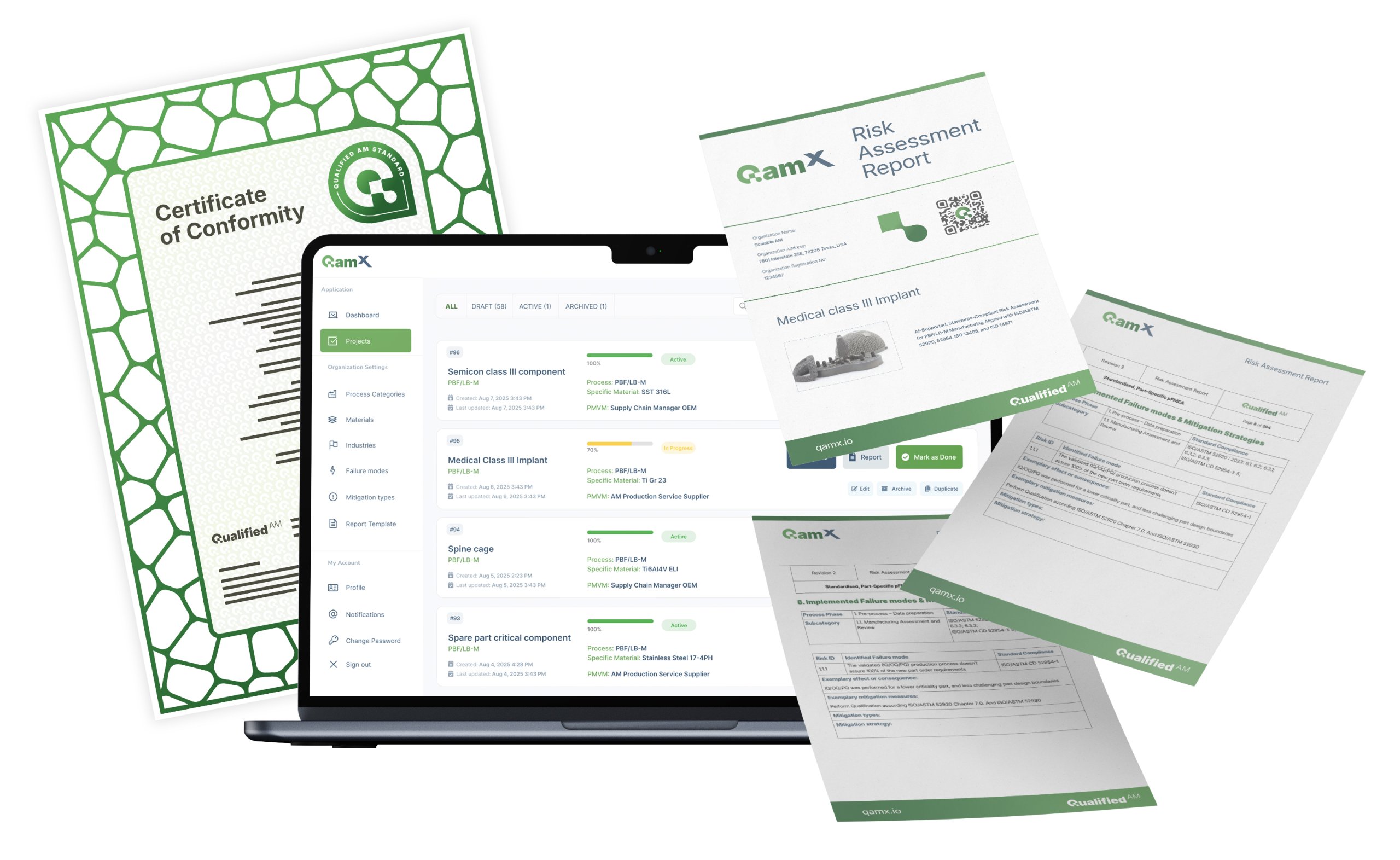
QamX Qualification Platform Unlocks Wider AM Industry Access
Qualified AM has officially opened its advanced QamX qualification platform to the broader additive manufacturing (AM) sector at Formnext 2026. After nearly two years of dedicated development, this strategic move aims to democratize access to robust qualification workflows. The platform integrates AI-powered risk assessment with a comprehensive, standards-based approach to managing evidence and reporting for AM equipment, materials, processes, and finished parts.
Table of Contents
To facilitate entry, Qualified AM is introducing the QamX Qualification Pass for €990 at Formnext. This pass serves as an accessible starting point for companies embarking on their initial qualification projects. The commercial release signifies a significant expansion of access to the QamX platform, which was initially previewed before Formnext 2025.
The software consolidates compliance management, risk assessment, and supplier traceability into a unified digital environment. Its modular design covers critical areas such as certification, quality management, supply chains, and production risk, providing a holistic solution for the evolving demands of industrial AM.
AI-Enhanced Qualification and Standards Integration
The 2026 iteration of QamX builds upon Qualified AM’s extensive experience in AM qualification and standards development. Founder and CEO Gregor Reischle highlighted that the platform’s underlying methodology is rooted in almost two decades of industrial AM expertise. Development began in 2014, evolving from early concepts like DIN SPEC 17071 into the recognized standard ISO/ASTM 52920.
Qualification is paramount as AM transitions into regulated production environments. A successful print is no longer sufficient; demonstrating a manufacturing process’s ability to consistently produce parts meeting stringent requirements is essential. QamX structures this complex process across equipment, materials, production capabilities, individual parts, and the supporting evidence required for validation.
The platform features four core software modules: RISK for risk assessment, QMS for quality management, CERT for qualification and compliance reporting, and SCM for supply-chain management. An AI assistant named Qami supports engineers by aiding in standards interpretation, identifying potential risks, suggesting mitigation strategies, and performing evidence-gap analysis. Qualified AM emphasizes an “AI supported, human approved” approach, ensuring that engineers and responsible parties retain final decision-making authority.
“QamX does not remove the engineering needed to prove that something is safe and qualified. It removes the need to rebuild the qualification logic around that engineering every time,” stated Reischle. This focus on reusable logic streamlines the qualification lifecycle significantly.
Streamlined Entry and Application in WAAM
The new QamX Qualification Pass offers a compelling entry point at €990 net, granting organizations four active months of QamX Foundation. This package includes support for one qualification project, two role-based users, and one production site. It also provides access to all four core modules (RISK, QMS, CERT, SCM) and the Qami AI assistant.
Included in the pass are ISO/ASTM 52920 and two additional applicable AM standards or specifications. Users also benefit from evidence storage, compliance and gap reporting features, and two hours of expert support from senior qualification specialists. Following the active period, users retain read-only access to project documentation for eight months.
Qualified AM is currently applying this methodology to a wire arc additive manufacturing (WAAM) production qualification project with German industrial manufacturer Vogelsang. This project involves an ABB industrial robot, a Fronius welding system, specific materials, and controlled process parameters, all framed by ISO/ASTM 52920 and related welding standards. The QamX platform connects these requirements with WAAM-specific failure modes, production risks, and component-use risks.

The company estimates that the initial QamX risk assessment for the Vogelsang project can be completed in approximately one to two working days once the standards and project structure are configured. While the physical qualification process is expected to take ten months to a year, QamX aims to deliver efficiency by reducing repetitive planning and evidence management, potentially making suitable applications up to 20 times more efficient through reusable knowledge.
Field Readiness and Future Outlook
Elements of the QamX approach have already demonstrated success in various industrial AM qualification projects. A Deutsche Bahn project, for instance, progressed from initiation to a qualified AM production site in roughly three months, encompassing QMS development and gap closure. At University Hospital Münster, ISO/ASTM 52920 was integrated into an ISO 13485-certified environment for a personalized aortic-arch application, showcasing its adaptability in the medical field.
The platform has also supported evidence and traceability during equipment certification audits, such as for Fieldmade’s NOMAD 03 system. Furthermore, it was utilized during an operational qualification exercise at the European Defence Agency’s AM Village 2026, highlighting its relevance in defense applications. The DILAPRO EU project further leverages QamX for assessing digital evidence against qualification requirements in laser-based manufacturing.
Qualified AM asserts that QamX does not replace independent certification or conformity assessment. Instead, it structures the evidence used to support these critical evaluations, ensuring a clear and organized submission process. The company is demonstrating QamX at Formnext 2026, Hall 12.1, Booth C71-1, with daily live demonstrations scheduled.
Source: 3D Printing Industry