
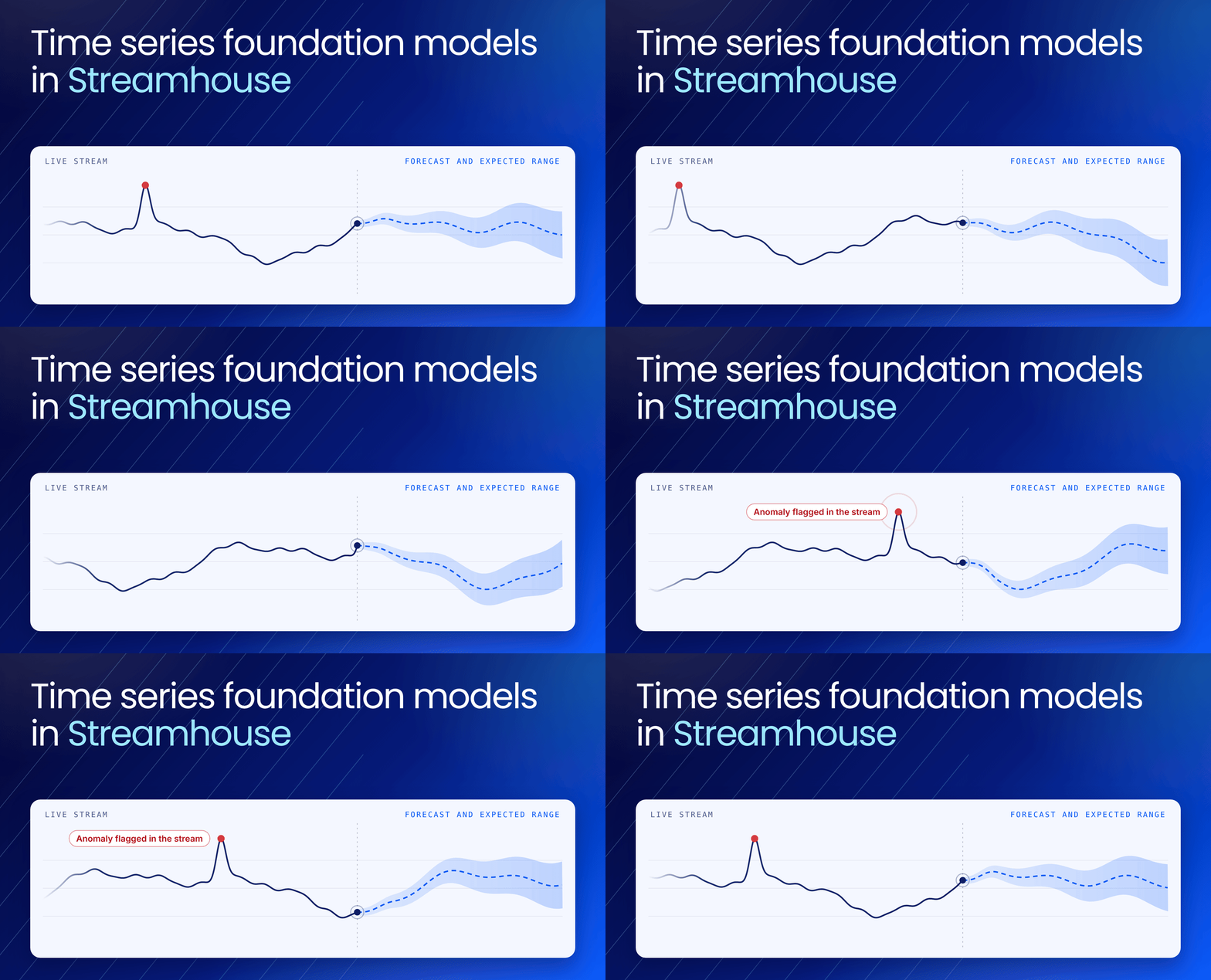
Time-Series Foundation Models: A New Frontier in Real-Time Analytics
The integration of time-series foundation models into Confluent’s Streamhouse marks a significant advancement in real-time data intelligence. With over 50 million downloads, these powerful IBM models are now natively available, enabling businesses to perform advanced forecasting, anomaly detection, and optimization directly on streaming data. This breakthrough allows for immediate insights and actions, transforming raw data streams into actionable intelligence without the need for complex, separate model training pipelines.
Table of Contents
Businesses continuously generate vast amounts of data, from machine telemetry to financial transactions. These data points form time series, which hold critical signals about future events. The challenge has always been to harness these signals in real-time, before they become obsolete. By embedding these models directly into the data flow via Apache Flink, Confluent and IBM are bridging the gap between data generation and decision-making.
[[IMAGE: A diagram illustrating the flow of time-series data being processed by foundation models within a streaming architecture, showing inputs like SCADA telemetry, sales data, and sensor readings, and outputs like forecasts, anomaly alerts, and optimized setpoints.]]Streamhouse Architecture and CPU-Centric Processing
The Streamhouse architecture on Confluent is designed to provide a unified view of current business context. It continuously captures, processes, governs, and serves data, ensuring that applications and AI agents operate on the most up-to-date information. Apache Flink serves as the processing engine, transforming and enriching data in motion, while Lightning Tables offer low-latency access to the current state.
The integration of time-series foundation models adds a predictive layer to this architecture. These models, which have learned general patterns from diverse historical data, can be applied to new series and tasks with minimal or no retraining. This significantly scales model development, as a single pretrained model can serve multiple use cases. Crucially, these models are optimized to run on standard CPUs, eliminating the need for expensive GPU infrastructure and simplifying deployment in both cloud and on-premises environments.
[[IMAGE: A close-up view of a CPU chip with glowing data streams flowing into it, symbolizing the efficient processing of time-series data by foundation models.]]Engineering Trade-offs: Scalability vs. Granularity
While the ability to run compact models on CPUs is a major advantage, it represents an engineering trade-off. The models are designed for broad applicability and efficiency, meaning they may not capture the highly specific nuances of every single data series without fine-tuning. The strength lies in their ability to provide a strong baseline prediction or anomaly detection across thousands of series simultaneously.
For instance, in production optimization, a model can forecast quality four hours ahead. However, achieving optimal results might require combining the model’s output with specific process parameters and operator expertise. Similarly, in fraud detection, a time-series signal provides individual cardholder context, but it complements, rather than replaces, existing sophisticated fraud detection systems. The true power emerges when these models are orchestrated with other AI systems, including large language models, to create a comprehensive intelligence layer.
Field Readiness and Verdict: Unlocking Proactive Operations
The practical applications of these time-series foundation models are vast and mission-critical. In manufacturing, they enable proactive quality control by forecasting product defects hours in advance, allowing for adjustments before significant rework is needed. This mirrors advancements in areas like 3D printing, where real-time monitoring and control are crucial for consistent output, as seen with innovations like WASP 3D printing achieving higher ceramic output.

Retail operations can leverage anomaly detection to identify unusual sales patterns, prompting timely stock replenishment or investigations. Supply chains benefit from hourly demand forecasts across all SKUs and stores, optimizing inventory levels and reducing stockouts. Even in financial services, these models enhance fraud detection by providing personalized spending behavior context for each cardholder.
The ability to refresh predictions as data changes and place signals closer to decisions makes these time-series foundation models invaluable. They are ready for deployment in demanding, real-time environments, offering a scalable and efficient path to unlocking proactive operations and data-driven decision-making across numerous industries.
Source: Hugging Face Technical Blog
URL: https://huggingface.co/blog/ibm-research/time-series-powered-streamhouse