
The Breakthrough of Surf-Roll: A Novel Tactile Feedback Illusion
The quest for immersive virtual reality experiences has led to innovative approaches in sensory feedback. A recent development, dubbed Surf-Roll, introduces a fascinating tactile feedback illusion that manipulates the perception of friction. This system allows users to feel virtual surfaces as either sticky or slippery by precisely controlling the relative speed between a touched surface and the user’s fingertip. This breakthrough in haptic technology opens new avenues for more realistic virtual interactions.
Table of Contents
The core principle behind Surf-Roll is a clever exploitation of human sensory expectations. When a person drags their finger across a surface, there’s an inherent expectation of how that surface should move relative to their skin. Researchers found that by exceeding this expected speed, the surface is perceived as slippery. Conversely, if the surface moves slower than anticipated, it creates a sensation of stickiness. This simple yet profound insight forms the basis of the Surf-Roll system.
Hardware and Software Architecture for Tactile Simulation
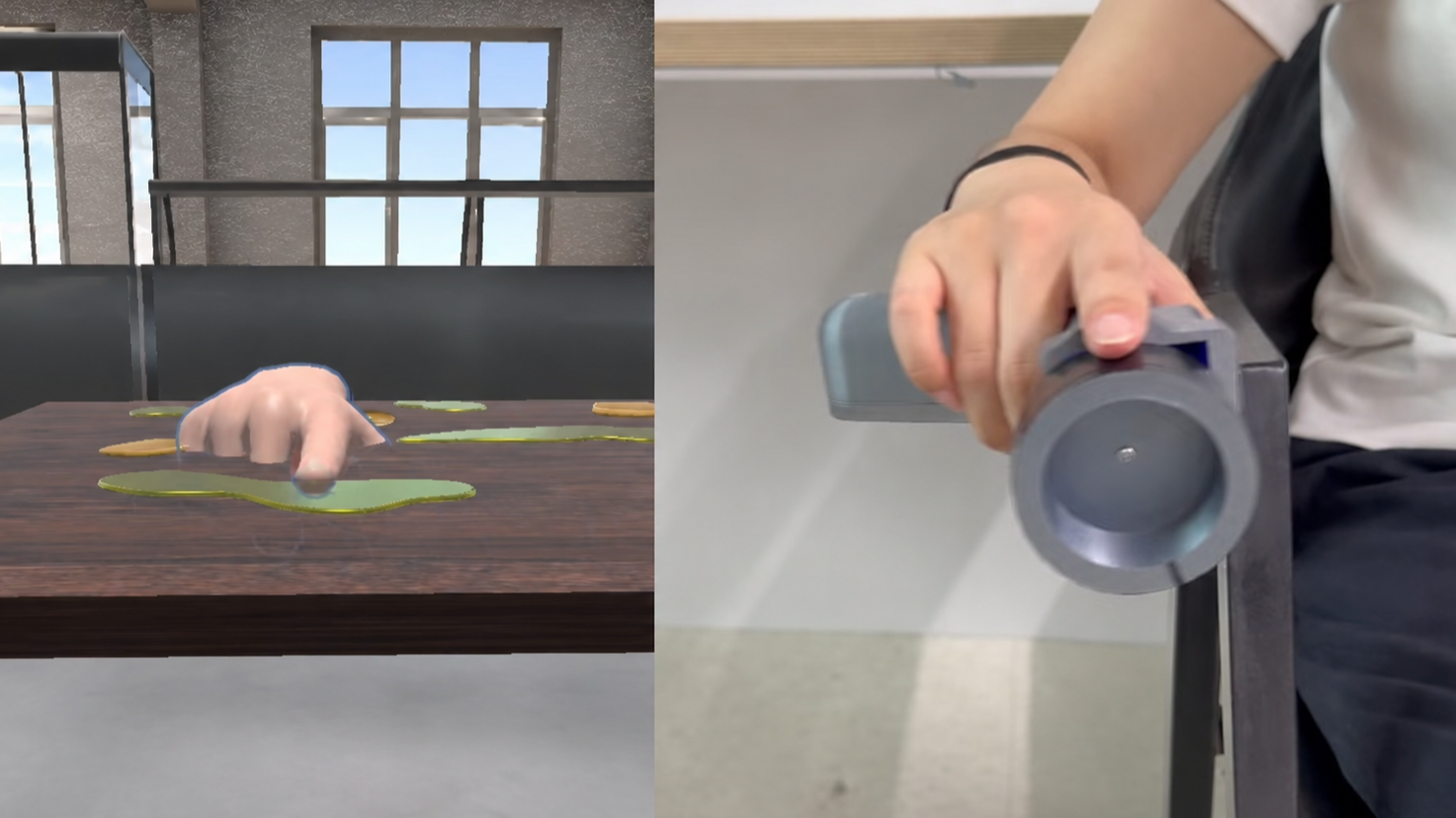
Surf-Roll is demonstrated using a relatively straightforward prototype that combines virtual reality with a specialized handheld device. The user’s fingertip rests on the surface of a small, integrated wheel. This wheel’s rotation speed is dynamically controlled by the VR environment, mirroring the perceived interaction with virtual elements.
When a user navigates through a virtual scene, the device’s wheel spins at a rate dictated by the virtual material. For instance, dragging a finger across a virtual tabletop might cause the wheel to spin at one speed, while moving through virtual oil or honey would trigger different rotational velocities. This synchronized movement is key to generating the tactile feedback illusion, making the virtual world feel more tangible.
The underlying software translates virtual surface properties into precise rotational commands for the physical wheel. This sophisticated interplay between visual and haptic feedback is crucial for the effectiveness of the tactile feedback illusion. Such advancements are vital for applications ranging from virtual training simulations to immersive gaming experiences, much like the detailed environments found in titles such as Walkabout Mini Golf.
Engineering Trade-offs and Perceptual Limitations
While Surf-Roll presents an intriguing method for simulating surface textures, it is not without its limitations. The system relies on a physical device, meaning the range of sensations is constrained by the hardware’s capabilities. The wheel’s maximum rotational speed and the precision of its control directly impact the fidelity of the sticky or slippery illusion.
Furthermore, the effectiveness of this tactile feedback illusion is subjective and can vary among individuals. Factors such as individual sensitivity to touch, prior experiences, and even the user’s visual perception within the VR environment can influence how accurately the illusion is perceived. The system’s reliance on a single point of contact (the fingertip on the wheel) also means it cannot replicate the complex tactile sensations of grasping or manipulating larger objects.
The development of such systems highlights the ongoing challenges in replicating the full spectrum of human touch in virtual environments. While impressive, the Surf-Roll prototype represents a specific type of tactile illusion, focusing on perceived friction rather than broader haptic feedback like texture, temperature, or pressure. Future iterations may need to incorporate more advanced actuators or multi-point contact interfaces to achieve greater realism.

Field Readiness and Future Verdict on Tactile Feedback
The Surf-Roll system, as demonstrated, is a proof-of-concept that showcases a novel approach to VR haptics. Its simplicity and the effectiveness of the generated tactile feedback illusion suggest significant potential for enhancing user immersion in virtual environments. The ability to convey basic surface properties like slipperiness and stickiness with a relatively simple mechanism is a notable achievement.
However, for widespread adoption, the technology would require further refinement and integration into more sophisticated VR hardware. The current prototype is a standalone demonstration, and its transition to commercial VR headsets or haptic gloves would necessitate significant engineering advancements. The ongoing research in areas like advanced AI for simulation, as seen with platforms like NXP i.MX 952 SoM, could potentially play a role in optimizing the complex algorithms needed for next-generation haptic feedback.
In conclusion, Surf-Roll offers a compelling glimpse into the future of VR sensory experiences. By focusing on a specific, yet impactful, tactile feedback illusion, it pushes the boundaries of what is possible in virtual interaction. While still in its early stages, this research lays important groundwork for creating more believable and engaging virtual worlds.
Source: Hackaday Engineering
One Comment