France Prepares Critical Salvage Operation for Stranded MIRO G Bulk Carrier
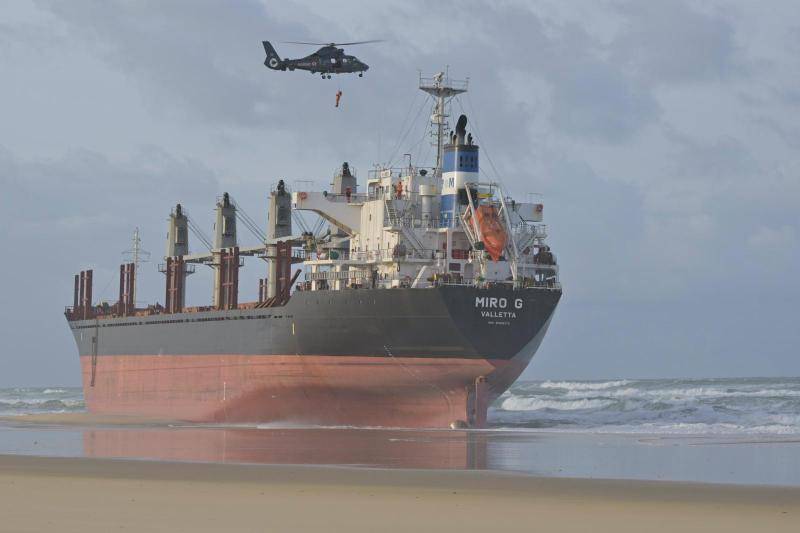
French authorities are mobilizing for a significant salvage operation aimed at freeing the Malta-flagged bulk carrier MIRO G. The vessel has been grounded on a beach along France’s Atlantic coast since encountering severe weather conditions last week. This complex undertaking highlights the advanced engineering and logistical coordination required in modern maritime recovery efforts.
Table of Contents
The Atlantic Maritime Prefecture confirmed that salvage teams dedicated the past weekend to thorough technical assessments and the meticulous assembly of necessary equipment. This preparatory phase is crucial for ensuring the safety and success of the upcoming refloating attempt near Cap de l’Homy in the Landes department.
Engineering the 1,900-Meter Towline: A Feat of Material Science
At the heart of the recovery plan is an extensive 1,900-meter (6,234-foot) towline. This critical piece of equipment is being prepared aboard the French emergency towing vessel Abeille Bretagne. Transported from the port of La Pallice, the towline is constructed from connectable 250-meter sections, each made from high-strength synthetic fiber.
The maritime prefecture highlighted the advanced properties of this synthetic material, noting its lightweight nature, buoyancy, and superior strength compared to steel on an equivalent weight basis. This choice of material is vital for maximizing pulling efficiency and minimizing strain during the high-stakes maneuver.
The successful deployment of such advanced materials echoes innovations seen in other technical fields. For instance, the development of high-strength synthetic fibers in maritime salvage shares a parallel with the robust materials used in advanced manufacturing, such as those enabling ultrasound support removal for metal additive manufacturing, which significantly speeds up production processes.
Optimizing Conditions for Refloating MIRO G
Before the primary towing attempt can commence, salvage engineers must first restore the vessel’s ballast pumping capability. This process is essential for removing accumulated water, thereby reducing the ship’s draft. Lightening the MIRO G is a key step to improving its buoyancy and increasing the likelihood of a successful refloat without causing further structural damage.
Simultaneously, salvage teams are closely monitoring an improving tidal window. Rising tidal coefficients are expected to provide over a meter of additional water depth at high tide, a significant improvement compared to the conditions present during the initial grounding on November 19. This favorable tidal trend is projected to continue through Thursday, November 26.
Wind and sea conditions are also showing signs of improvement, although authorities caution that the environment remains challenging. Forecasts indicate the potential for further strong winds in the coming days, necessitating careful timing of the salvage operation.
Engineering Trade-offs and Risk Mitigation in Maritime Salvage
The MIRO G ran aground during the night of November 19–20, driven towards the coast by powerful winds and heavy seas after initially anchoring approximately three nautical miles offshore. The grounding triggered a swift, coordinated maritime emergency response involving both French and Spanish authorities.
The Spanish salvage tug Sar Gavia and the French tug Abeille Bretagne were deployed to the scene. Personnel aboard the MIRO G were safely evacuated by helicopter, underscoring the immediate priority placed on human safety. The French maritime prefect subsequently ordered the shipowner to arrange the vessel’s prompt refloating.
A critical consideration in this complex salvage operation is the risk of the vessel settling deeper into the sand the longer it remains grounded. This presents a significant engineering trade-off: the urgency to free the ship versus the increasing difficulty and potential for damage associated with a prolonged grounding. Even a successful initial tow could be complicated by offshore sandbanks.

To mitigate potential environmental hazards, authorities are pre-positioning pollution-response resources both on land and at sea. This precautionary measure is vital in the event of any accidental release of fuel or other pollutants during the refloating process.
The decision to proceed with the towing attempt hinges on a delicate balance. No action will be taken until all necessary technical preparations are finalized and weather and sea conditions are deemed suitable. This methodical approach ensures that the risks associated with this challenging salvage operation are managed as effectively as possible.
Field Readiness and Verdict on the MIRO G Salvage
The MIRO G incident underscores the critical importance of robust maritime infrastructure and rapid response capabilities. While the specific technical details of the MIRO G’s systems are not fully public, the reliance on powerful tugs and advanced towing equipment is standard in such operations. This mirrors the need for reliable hardware in other critical infrastructure, such as the Mantsinen 200 Material Handler, which uses 510hp electric power to unlock terminal efficiency.
The ongoing salvage operation is a testament to the preparedness of French maritime authorities and the capabilities of specialized salvage companies. The successful execution of this complex maneuver will depend on precise engineering, favorable environmental conditions, and effective coordination among all involved parties.
The final verdict on the success of this salvage operation awaits the outcome of the refloating attempt. However, the meticulous planning and the deployment of advanced resources demonstrate a commitment to resolving the situation efficiently while prioritizing safety and environmental protection. The outcome will be closely watched within the maritime industry.
Source: gCaptain Maritime Tech