Lithoz CeraFab S65 Performance Pack: A Breakthrough in Ceramic 3D Printing
Lithoz has announced a significant advancement in ceramic 3D printing with the introduction of its CeraFab S65 Performance Pack at Formnext 2026. This optional upgrade dramatically enhances the capabilities of the CeraFab System S65 and S65 Medical by doubling the projected light intensity and increasing resolution. This innovation promises to unlock new possibilities for complex ceramic components across various industries, from aerospace to medical implants.
Table of Contents
The Performance Pack is engineered to overcome key challenges in Lithography-based Ceramic Manufacturing (LCM) technology, particularly with darker ceramic materials. By doubling the light intensity to approximately 120 mW/cm² and refining the optical resolution to 1016 dpi, Lithoz is pushing the boundaries of what can be achieved with light-based additive manufacturing for ceramics.
Hardware and Software Architecture: Doubling Light Intensity and Resolution
At the core of the CeraFab S65 Performance Pack is an optional 4K projection system. This system is meticulously designed to boost both the optical resolution and the curing power of the LCM process. The projected light intensity is effectively doubled, increasing from the standard 60 mW/cm² to an impressive 120 mW/cm².
Furthermore, the resolution sees a substantial upgrade, moving from 635 dpi to 1016 dpi. This translates to a reduction in the projected pixel size from 40 µm down to 25 µm. This finer pixel pitch represents a 60% increase in pixel density, enabling the creation of significantly more intricate geometric details in the final ceramic parts.
The LCM process itself involves using projected light to selectively cure photosensitive ceramic suspensions. The resulting ‘green’ parts then undergo thermal post-processing, including debinding and sintering, to achieve their final ceramic properties. The enhanced light intensity is crucial for ensuring consistent curing, especially with darker ceramic slurries that tend to absorb more light, thereby limiting penetration depth.
Engineering Trade-offs and Limitations in Advanced Ceramic Manufacturing
While the Performance Pack offers substantial benefits, understanding the engineering trade-offs is essential. The increased light intensity directly addresses the challenge of curing darker ceramic materials, making them more accessible for LCM. This expansion of material processing capabilities is a key advantage, opening doors for new applications where specific material properties are required.
However, the company has not yet released comparative data on dimensional accuracy for components printed with the new system. While the reduction in pixel size suggests improved detail, real-world performance in terms of geometric fidelity and tolerance control will be critical for high-precision applications. This is a common consideration in advanced additive manufacturing, where achieving both fine detail and tight tolerances requires careful process optimization.
The advancements in ceramic 3D printing echo developments in other high-performance computing fields, such as the need for powerful GPUs to handle complex simulations. For instance, advancements like those seen with the NVIDIA RTX Spark, which offers 1 Petaflop of AI processing, highlight the increasing demand for computational power in design and manufacturing, a trend that extends to the precision required in additive manufacturing.

Field Readiness and Verdict: Paving the Way for Next-Gen Ceramic Applications
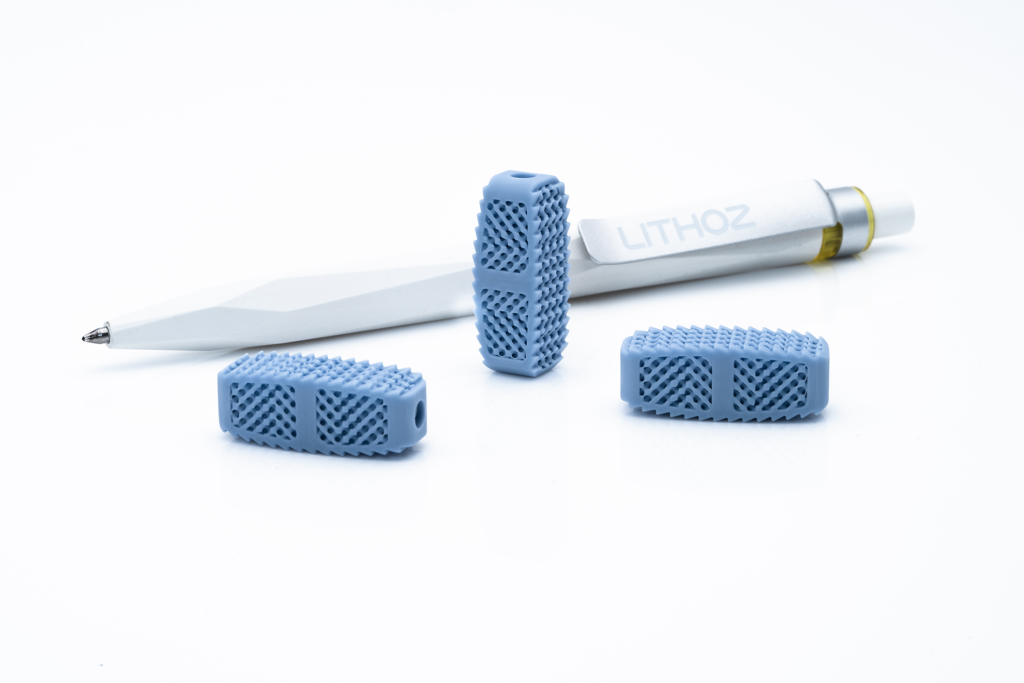
Lithoz is demonstrating the capabilities of its expanded portfolio at Formnext 2026, showcasing diverse applications. These include high-volume production of aluminium nitride cooling plates for thermal management, complex ceramic cores for aerospace turbine blades, and patient-specific hydroxyapatite spinal cages for medical use. The latter, co-developed with Spherene, utilizes an Adaptive Density Minimal Surface (ADMS) approach, blending advanced materials with patient-specific geometries.
In the energy sector, DTU Energy is presenting monolithic, gyroid-shaped solid oxide fuel cell (SOFC) units that boast an impressive power-to-weight ratio, potentially revolutionizing hydrogen-powered transportation. Other exhibits feature zirconia watch bezels and lead-free piezoceramic components for miniaturized medical sensors.
The CeraFab S65 Performance Pack positions Lithoz at the forefront of ceramic 3D printing innovation. By enhancing light intensity and resolution, the company is making advanced ceramic materials more processable and enabling the creation of highly complex, functional parts. This development is set to accelerate the adoption of ceramic additive manufacturing in demanding fields, solidifying its role in the future of industrial production.
Source: 3D Printing Industry